 (1 votes, average: 5.00 out of 5)
 Loading...
Fullscreen








![Hello Kitty [HORROR]](https://gamefyno.com/wp-content/uploads/2025/03/hello-kitty-horror-1.jpg "Hello Kitty [HORROR]")
 (1 votes, average: 5.00 out of 5)Loading...
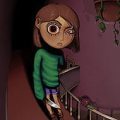
 The House 2 looks like another point-and-click horror curiosity you click through once and forget, but the full game plays like a time-loop puzzle box built specifically to punish that kind of quick assumption. Tabby doesn’t just explore a haunted house here; she relives the same storm-battered night over and over until she either breaks the curse or becomes part of it.
Unlike the earlier browser version of the house, which moved players linearly from room to room toward a single ending, the full game traps Tabby in a repeating night where family members can die in different ways depending on what she does or fails to do in time. That loop structure turns exploration into information gathering rather than a one-time walkthrough.
Dying or failing to save someone doesn’t end the game outright; it resets the loop with the knowledge you’ve gained, which means early failures are expected rather than punishing in the way a single-path horror game would treat them.
Players coming from the original flash-style browser version sometimes expect the same short, note-collecting pace, and are caught off guard by how much longer a full run through the loop actually takes once multiple family members need saving in the same cycle.
Every choice Tabby makes nudges the house’s overall state toward Pure or Corrupt, and that alignment shapes which of the game’s multiple endings become available. Consistently saving family members and creatures pushes toward the gentler outcomes, while repeated killing pulls the story toward its darker resolutions.
This system rewards players who commit to one approach across a full loop rather than mixing saves and kills inconsistently, since the house seems to track the overall pattern rather than any single decision in isolation.
Achievement hunters chasing every ending tend to keep a running note of which choices pushed the story which way, since the full game doesn’t spell out the alignment shift in obvious terms while you’re making it.
One of the loop’s key sequences involves defeating three specific threats, the brain, the mouth, and the hand, before Tabby can escape a particular nightmare stretch. The mouth in the backyard is dealt with by retrieving the anvil from the basement and throwing it, a solution that only becomes obvious after enough failed attempts to notice what items interact with what obstacles.
This kind of item-to-obstacle logic runs through the rest of the loop as well, and it’s the part of House 2 that most divides players: some find the trial-and-error discovery deeply satisfying once a solution clicks, while others find repeating the same early loop segments to re-test a theory genuinely tedious.
Notes and background details still matter here the same way they did in the browser original, but in the full game they’re often clues toward solving a loop obstacle rather than pure lore for its own sake.
Between loop attempts, House 2 lets players interact with the BarkStation, a small in-house arcade offering retro-style minigames that have nothing to do with escaping the curse. It’s a strange but welcome breather in a game otherwise built around mounting dread.
Whether the BarkStation adds meaningful pacing or just delays the next attempt is something players disagree on, particularly those speedrunning toward a specific ending versus those savoring the atmosphere on a first playthrough.
Either way, it’s one of several details that separates the full game’s density from the comparatively sparse browser version, where no equivalent distraction ever existed.
Every loop through House 2 adds another layer to what Tabby’s night actually means, and between the anvil-and-mouth puzzle, the pull toward Pure or Corrupt, and the odd comfort of the BarkStation between attempts, the full game earns its title by turning a once-simple haunted house into something players keep resetting just to understand a little better.

There are no reviews yet. Be the first one to write one.
 Optimized by Seraphinite Accelerator