![Hello Kitty [HORROR]](https://gamefyno.com/wp-content/uploads/2025/03/hello-kitty-horror-1.jpg "Hello Kitty [HORROR]")
 (No Ratings Yet)
 Loading...
Fullscreen
















 (No Ratings Yet)Loading...
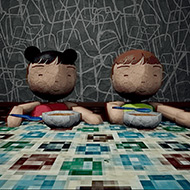
 In Hello Kitty [HORROR] you start with a messy room, a yawning character who clearly needs to be in bed soon, and a checklist of small chores that has nothing frightening about it at all, which matters because the tag in the title sets up an expectation the actual routine never pays off. What’s here instead is a calm, structured wind-down sequence built for very young players.
The loop is straightforward: tidy scattered toys back into their spots, guide the character through brushing teeth and a quick bath, and finish with a short storytime segment before the lights go out. Each step is simple enough that a preschool-aged player can follow it without reading instructions, tapping objects in roughly the order the room presents them.
None of these steps escalate into anything tense. There’s no timer pressure, no failure state that punishes a wrong tap, and no hidden twist waiting once the room is clean. The game’s actual identity is a bedtime-routine simulator dressed up under a title that promises something it was never built to deliver, and it’s worth saying plainly that the content itself never earns the horror label at any point.
Even without stakes, the sequence of cleaning, washing up, and storytime is deliberately paced to mimic an actual bedtime routine, and younger players tend to respond well to that structure precisely because it’s predictable. Skipping ahead isn’t really possible; the room-tidying has to finish before the wash-up stage unlocks, and the wash-up stage has to finish before the story does.
Parents and older siblings playing alongside a younger child tend to describe the value here less as challenge and more as repetition-friendly comfort. A four- or five-year-old can run through the same tidy-wash-story sequence multiple times without it feeling stale, since the appeal is in the familiar rhythm rather than in any variation between playthroughs.
The most common point of confusion, understandably, is the title itself. Players arriving expecting jump scares or a tense atmosphere are met instead with soft colors, a sleepy character, and a fairy tale at the end, and that mismatch is worth flagging honestly rather than pretending the horror framing pays off somewhere later. It doesn’t. What’s here is a gentle caretaking activity, and it’s best approached with that expectation set correctly from the start.
Discussion around games in this bedtime-routine genre tends to focus on how forgiving the interface is for small hands and short attention spans, and Hello Kitty [HORROR]’s tap-to-interact chores fit that pattern closely, favoring big, obvious touch targets over anything requiring precision.
No. Despite the title, the content is a calm bedtime-routine activity with no jump scares, no threat, and no failure state; the tasks are tidying, hygiene, and a short storytime.
Not really. The steps unlock in a fixed sequence, so a player can’t meaningfully fail a stage, only take longer to finish tapping through the objects presented in each room.
The pacing, touch targets, and subject matter are all aimed at very young children, closer to a caretaking simulator than a challenge-driven game, and it plays best with that audience in mind rather than anyone expecting the horror the title implies.
Hello Kitty [HORROR] is best understood on its own terms once the title’s promise is set aside: a short, repeatable bedtime routine built for small children, where the reward is the calm predictability of tidying up, washing up, and settling in for a story, not anything the name suggests.


There are no reviews yet. Be the first one to write one.
 Optimized by Seraphinite Accelerator