 (1 votes, average: 5.00 out of 5)
 Loading...
Fullscreen













![Hello Kitty [HORROR]](https://gamefyno.com/wp-content/uploads/2025/03/hello-kitty-horror-1.jpg "Hello Kitty [HORROR]")
 (1 votes, average: 5.00 out of 5)Loading...
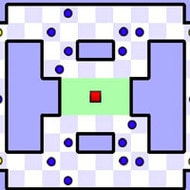
 Worlds Hardest Game 3 looks like a red square wandering across a colored floor plan, but it plays like a timing exam where every blue ball is a trick question. You move with the arrow keys, you collect yellow coins, and you die the instant your square touches a ball. What sets it apart from older entries in the series is that the rooms now connect, so you are not only surviving screens but also finding your way between them.
Every room follows the same contract: take every yellow coin and the exit opens. Skip one coin and the way forward stays shut, which forces you to plan a route through the balls instead of sprinting for the door. Green zones work as checkpoints, so a good run is really a chain of short problems.
Keys are the new layer. Finding a key opens passages that lead into other rooms, so the map matters as much as your reflexes. Press P or the pause button to see it and check where you are heading before you commit to a route.
Early in the game the coin placement is forgiving, but once the first keys appear a single room can ask you to combine coins and keys in one pass. Slowing down at that point saves more deaths than any twitch reflex.
The blue balls move in fixed loops, and that is the mercy of the design: nothing is random. Watch a full cycle before you touch anything, then look for the pockets where you can stand safely and wait for the next gap. Beginners usually make the same error, which is moving on a guess and hoping the gap arrives in time.
Movement itself is unforgiving. The square stops exactly where you release the key, with no sliding or momentum, so pixel-perfect taps beat long holds. Once you accept that, tight corridors stop looking impossible and start looking like a sequence of tiny steps.
Three habits separate players who progress from players who loop:
Every player knows the death where a ball seemed to miss by a mile, yet the square restarts anyway. That is a corner of your square clipping the edge of a ball, and it is why experienced players leave a pixel of clearance whenever they can.
The first game in the series runs through 30 levels in a straight line: finish one, move to the next. The third entry swaps that ladder for connected rooms, keys, and locked passages, so the challenge is partly navigation. Individual screens are still brutal, but the game now asks where to go as well as how to survive.
Fans are split on the change. Purists miss the clean one-screen tension of the original, where nothing stood between you and the next stage but the balls. Others enjoy having a place to explore and the small relief of seeing progress on the map after a long streak of deaths.
Is it harder or easier? Neither, exactly. The danger in each room feels comparable, but the extra routing makes mistakes less obvious, because a death can come from a bad plan made rooms ago rather than from a slip of the fingers.
The game tracks your deaths, and that counter shapes how different players approach it. Perfectionists chase a low death count and restart a room the moment they take a hit they consider avoidable. It is a legitimate way to play, although it can turn a puzzle into a grind.
Speedrunners treat the same map as a route-planning problem. They memorize which coins, keys, and doors matter, cut everything else, and reduce each room to a rehearsed line through the blue balls.
Casual players get the best deal from the green checkpoint. A checkpoint turns one impossible room into two survivable halves, and it is often the difference between quitting and finishing. Treat the death count as noise until you are comfortable, and let the checkpoints do their work.
Worlds Hardest Game 3 rewards the player who watches before moving: study the blue balls, take every yellow coin, lean on the green checkpoint, and check the map after each key. Do that and the death count stops being the main story.
There are no reviews yet. Be the first one to write one.
 Optimized by Seraphinite Accelerator