 (1 votes, average: 5.00 out of 5)
 Loading...
Fullscreen











![Hello Kitty [HORROR]](https://gamefyno.com/wp-content/uploads/2025/03/hello-kitty-horror-1.jpg "Hello Kitty [HORROR]")
 (1 votes, average: 5.00 out of 5)Loading...
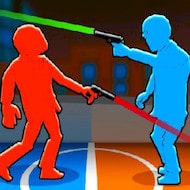
 In Ragdoll Duel 2P you begin with a loaded gun, a limp ragdoll arm, and exactly one button, which matters more than it sounds. Your rival stands across from you with the same problem, and neither of you can simply point and shoot. Every shot pushes your own arm around, so the duel is really a fight to control the swing.
The whole system comes down to timing. Your ragdoll’s arm hangs loose, and the only way to move it is by firing. Each shot kicks the arm, and a shot fired at the right moment carries it upward toward your rival, while a badly timed shot slows or stalls the swing entirely.
That is why raising the gun is a rhythm rather than an aim. Tap, watch the arm rise, tap again as it swings, and release the last shot when the barrel finally lines up with your rival. Players who find the beat make the arm climb quickly, while those who wait too long watch it flop back down.
Learning to feel that rhythm takes a few rounds. Early on the arm seems to have a will of its own, but after a handful of duels you start reading how far each kick sends it.
The classic mistake is mashing blindly from the first frame. Frantic tapping sends the arm in unpredictable directions, and the bullets end up in the wall behind your rival instead of in their ragdoll. Speed matters, but only after the arm is already pointing the right way.
The second mistake is ignoring what your rival’s arm is doing. Both ragdolls wobble, so the moment their gun swings away from you is a chance to reset your own rhythm rather than a moment to panic. Watching their arm gives you a spare second to plan.
The third is forgetting how short a match is. With the winner decided by the first to take three rounds, one careless duel can put you behind, and the pressure builds fast. Staying calm is usually worth more than raw speed.
Choose the 2P option and the game becomes a living-room duel. One player fires with W and the other with the Up Arrow, so two people share a keyboard with a single key each. It takes a few seconds to teach, and it turns into a shouting match once the arms start flailing.
The winner is whoever takes three rounds first, and a round ends when a rival’s energy indicator hits zero. Because the arms are so unpredictable, comebacks are common, which keeps friends playing another match instead of arguing over the result.
Competitive players will find their skill shows up in consistency rather than flashy shots, while casual friends will enjoy the slapstick without caring much about the score. Both groups get something out of the same match.
Solo mode pits you against a bot that gets stronger after each round. Coins you earn in solo play can be spent to raise your health and your weapon power, which is what keeps you in the fight as the rounds go on. Players who grind a few extra coins before pushing forward tend to feel the difference quickly.
The heart icon boosts your health when you click it, and the bolt icon boosts your power. Both are worth timing carefully, because using a boost during a quiet moment wastes what it could do in a crisis.
The energy indicator shows how close either duelist is to losing a round, and the three squares above it track who is closer to winning the match. Glancing at it every few shots tells you whether to play safe or take the gamble.
Players disagree about this. Critics say the swinging arm makes results random, since a great shot can go wide because of one bad kick. Defenders answer that the same physics rewards anyone who learns the rhythm, and that experienced players do pull ahead over a long session.
Both sides have a point. A single round can turn on a lucky flail, but across a run of matches the calm player who stops mashing tends to come out ahead. The game is honest about being silly, and that silliness is much of the appeal.
One detail every regular recognizes is the moment both arms swing up at once and neither player dares fire first. It is a strange, tense stand-off that a normal shooter would never produce.
Ragdoll Duel 2P gets its drama from a tiny set of ingredients: a swinging gun arm, an energy indicator that shrinks with each hit, and a race to win three rounds. Learn the rhythm of the recoil, save the heart icon and bolt icon for the rounds that need them, and the flailing starts to look like skill.

There are no reviews yet. Be the first one to write one.
 Optimized by Seraphinite Accelerator