
 (1 votes, average: 5.00 out of 5)
 Loading...
Fullscreen













![Hello Kitty [HORROR]](https://gamefyno.com/wp-content/uploads/2025/03/hello-kitty-horror-1.jpg "Hello Kitty [HORROR]")
 (1 votes, average: 5.00 out of 5)Loading...
 What happens when the camcorder filter stops feeling like an aesthetic choice and starts feeling like the only thing standing between you and whatever is actually in the room? That’s the question Your Happy Place keeps circling back to, and it never really answers it, which is part of why the game has stuck with people who finished it.
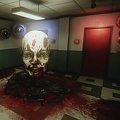
The recording-style visual filter is the first thing anyone mentions about Your Happy Place, and for good reason. Every hallway and waiting room is rendered through that grainy, slightly warped camcorder lens, and it does real work beyond nostalgia. Shapes at the edge of the frame are harder to confirm, light sources smear a little, and that ambiguity is where most of the tension in the early minutes comes from.
Movement is simple by design. WASD to move, mouse to look, E to interact, nothing more complicated than that. The game leans entirely on atmosphere instead of mechanical complexity, which is a deliberate choice that separates it from horror games built around puzzles or inventory management.
Players who came in expecting jump scares tend to be the ones most unsettled by the pacing, since Your Happy Place mostly withholds them in favor of sustained unease.
The eyeball creatures are the closest thing the game has to a recurring threat, and community reaction to them is split almost evenly. Some players find them genuinely unnerving on first encounter, describing the sensation of being watched long before anything visibly appears. Others, once they’ve played through a full session, say the creatures are more atmospheric set dressing than active danger, and that criticism shows up often enough in comments that it’s worth stating plainly here.
Exploration-minded players tend to linger in each room longer than the pacing seems to intend, hunting for detail the VHS filter deliberately obscures. Speedrun-curious players, by contrast, treat the roughly thirty-minute average session as a target to beat, which changes how tense any given room feels considerably.
By the time you reach the game’s final stretch, the tone shifts from disorientation into something closer to dark comedy, and the ending is the moment most write-ups single out. Without spoiling the specifics, it involves a shopping cart and an image that several players have described as the funniest gut-punch they’ve gotten from a horror game all year. It’s the detail that turns Your Happy Place from a solid liminal-space exercise into something people actually remember and recommend afterward.
Some players initially mistake this sequence for a bad ending and go looking for an alternate outcome, only to find that it is, in fact, the intended conclusion. That confusion has become its own small recurring topic in the comments section.
Dark_Knife15’s earlier release, My Happy Place, functions almost as a quiet predecessor here, and the title itself is clearly a callback. Players familiar with the developer’s back catalog tend to notice environmental touches that echo the earlier game, though Your Happy Place stands on its own without requiring that history.
The project began years earlier as an unfinished prototype before being completed for the Liminal Game Jam 2026, and that development gap shows in a good way: environments feel considered rather than rushed, even in a fairly short overall runtime.
Your Happy Place earns its reputation less through raw scares and more through the specific, deliberate weirdness of its final shopping cart image, the kind of detail that turns a solid liminal-horror entry into one players actually keep bringing up months later.

There are no reviews yet. Be the first one to write one.
 Optimized by Seraphinite Accelerator