
 (1 votes, average: 5.00 out of 5)
 Loading...
Fullscreen
















![Hello Kitty [HORROR]](https://gamefyno.com/wp-content/uploads/2025/03/hello-kitty-horror-1.jpg "Hello Kitty [HORROR]")
 (1 votes, average: 5.00 out of 5)Loading...
 What happens when the friend guiding you through your old school stops feeling like a friend? That question sits underneath every quiet hallway in Sabado: Day One, and it doesn’t announce itself until you’ve already let your guard down.
| Genre | Psychological Mystery Horror |
| Style | Filipino Anime-Inspired |
| Setting | Kiwi High School |
| Perspective | Third-person exploration |
Sabado: Day One opens with a premise that sounds gentle on paper: you’re revisiting Kiwi High School, walking classrooms and corridors that used to feel like home. That gentleness is deliberate. The game leans on nostalgia first, letting you wander familiar spaces and half-remembered rooms before it starts pulling threads loose.
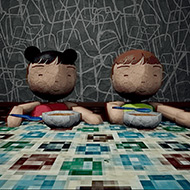
Chesa meets you early and stays close for most of the playable demo. She reads as warm and a little too eager to reminisce, which is exactly the tone the game wants players second-guessing by the midpoint. Longtime fans of the genre — the ones who track every anime horror game release on itch.io — tend to clock her behavior shifts faster than players coming in cold.
Jacob appears as a secondary voice through the school, with dialogue that’s still being reworked across patches, and his presence adds another layer of who-do-you-trust uncertainty to a school that should feel empty but rarely does.
One of the more talked-about mechanics is simply matching Chesa’s walking pace. Players consistently report overshooting her and ending up ahead instead of beside her, which breaks the intended rhythm of scenes meant to unfold at her speed, not yours.
This isn’t a bug so much as a tension point the community argues about openly. Some players find the slow walk essential to the mood; others find fifteen minutes of matched pacing genuinely tedious by the third room. Both reactions show up constantly in comments, and it’s worth going in expecting that friction rather than being surprised by it.
Camera behavior compounds this for some setups — a stutter that shows up specifically while walking, independent of frame rate, which several players have traced to how the engine handles movement sync rather than a hardware issue on their end.
Early in the game, a television-watching sequence introduces the first real timed pressure players encounter. As of the most recent patch, that window was reduced from sixty seconds down to thirty, tightening a moment that previously gave players more room to hesitate.
This section functions as a soft difficulty check. Players who’ve spent the earlier rooms rushing through dialogue tend to miss context that makes the shortened timer far more stressful than it needs to be.
An item referred to in-game as Beads — renamed from an earlier build where it was labeled “Beed” — factors into how Chesa reacts to certain rooms. Players hunting for every narrative thread tend to backtrack specifically to confirm they haven’t missed an interaction tied to it, since Sabado: Day One rarely flags optional content explicitly.
By the time you reach the Dream Start sequence, the game has usually already reframed at least one earlier scene, which is the moment most players describe as the turning point where “revisiting a fond memory” stops being an accurate description of what’s happening.
Recent patches have specifically increased Chesa’s voice line volume and adjusted her homeroom dialogue, changes the developer made in direct response to community feedback about audio balance. It’s a small detail, but it signals a team actively tuning the game around how players are actually experiencing it, not just how it was designed on paper.
Character design consistently gets singled out as the strongest element even among players who found the pacing frustrating — a rare point of near-universal agreement in an otherwise divided comment section.
Sabado: Day One earns its unease slowly, trading jump scares for the specific discomfort of watching Chesa’s warmth curdle a little more with every room you two walk through together. It’s a game that asks you to sit in its silences, even when the silence is the scariest part.

There are no reviews yet. Be the first one to write one.
 Optimized by Seraphinite Accelerator