 (1 votes, average: 5.00 out of 5)
 Loading...
Fullscreen











![Hello Kitty [HORROR]](https://gamefyno.com/wp-content/uploads/2025/03/hello-kitty-horror-1.jpg "Hello Kitty [HORROR]")
 (1 votes, average: 5.00 out of 5)Loading...
 What actually happens when the train at the center of Lyrvane Park needs fuel it was never built to run on? That question sits at the middle of everything the game asks you to do, and the answer — feeding it captured emotion instead of coal or diesel — is stranger and more uncomfortable than it sounds once you’ve done it a few times.
| Genre | First-person meta-horror puzzle adventure |
| Setting | An abandoned, 1980s-styled amusement park |
| Core Mechanic | Harvesting emotion with the Radar of Emotions |
| Achievements | 14 Steam achievements |
The device you carry through most of Lyrvane Park isn’t a flashlight or a weapon — it’s a Radar of Emotions, and its entire job is pulling residual feeling out of the environment and storing it as usable charge. That charge is what opens locked doors, restarts the park’s train, and powers dormant attractions scattered along the route, which means exploration and resource management end up being the same activity rather than two separate systems layered on top of each other.
New players tend to burn charge carelessly on the first few doors they see, only to find themselves short when the train genuinely needs to move. The game doesn’t warn you about this directly; it just lets the shortfall happen and expects you to plan better on your next attempt at that stretch of track. Once you understand that every stored emotion is finite and every unlock has a cost, the whole park starts to feel less like a sandbox and more like a budget you’re constantly renegotiating with yourself.
The unsettling part isn’t the mechanic itself, it’s the implication baked into the description of the device — that the radar doesn’t just measure what it collects, it remembers it, and later sequences in the game start reacting to earlier choices in ways that make it clear the tool has been quietly logging you the entire time. Players who like piecing together environmental storytelling tend to obsess over this detail specifically, cross-referencing radar behavior with the letters scattered around the park to figure out what it’s actually tracking.
Scattered letters — referred to in-game simply as mails — carry most of the park’s backstory, and they read like they were written in a hurry, or deliberately hidden by whoever left them. Piecing together what actually happened at Lyrvane Park before you arrived means reading between those letters rather than expecting the game to hand you a clean explanation anywhere else.
Gifts are a separate collectible track entirely, tucked into corners that have nothing to do with progressing the main path forward. They don’t help you survive a single encounter, and the game is upfront about that — their only real purpose is proving you searched every uncomfortable corner of the park, which is exactly the kind of challenge completionist players gravitate toward even when there’s no gameplay incentive attached.
Lore-focused players tend to prioritize mails on a first playthrough, piecing together the timeline before worrying about anything else, while achievement hunters usually save the gift hunt for a dedicated second pass once they already know the layout well enough to search efficiently.
The train is the spine of Lyrvane Park’s progression — it’s the only realistic way to reach the park’s furthest sections, and it runs entirely on the emotional charge you’ve collected rather than anything conventional. The game states plainly that the price per mile increases the deeper you push, which turns later train rides into genuine decisions rather than automatic progress: do you spend everything you’ve saved to reach the next stretch, or hold some back in case a door along the way demands it too?
By the time you’re several sections deep and the train demands a noticeably larger charge than it did at the start, most players have already learned to treat every emotional pickup as delayed spending rather than immediate profit. That shift in mindset is arguably the game’s real difficulty curve, since the puzzles themselves stay fairly readable throughout.
Signs marking areas as staff only aren’t just set dressing in Lyrvane Park — they gate some of the darkest content the park has, and getting past them almost always costs more radar charge than the doors out in the open sections. The game leans on this restriction to pace how much of its darker material you see early, rather than locking it behind a difficulty setting or a separate mode.
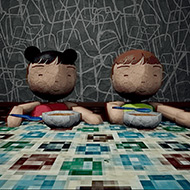
One thing players openly disagree on is the tonal mix — the visual style leans bright and cartoony even as the subject matter gets genuinely dark, and that contrast either lands as unsettling in exactly the way the game intends, or feels tonally confused depending on who you ask. It’s a fair point of debate, and one that shows up in almost every discussion thread about the game rather than being a minor nitpick.
It captures leftover emotional energy from the environment and stores it as charge you spend to open doors, restart the train, and activate attractions — and later sequences suggest it retains more information about what it’s collected than the game initially lets on.
You need enough stored charge from the Radar of Emotions, and these doors generally demand more than the ones in publicly accessible areas, which usually means saving up rather than spending everything on the first locked door you find.
Yes, but the story is deliberately fragmented across the mails scattered through the park rather than told directly, so getting the full picture takes deliberate searching rather than just following the main path forward.
Lyrvane Park works because it never lets you forget that the Radar of Emotions is doing something to you as much as for you, and long after you’ve stepped off the train for the last time, that quiet unease about what the device actually recorded is what sticks.

There are no reviews yet. Be the first one to write one.
 Optimized by Seraphinite Accelerator