
 (No Ratings Yet)
 Loading...
Fullscreen











![Hello Kitty [HORROR]](https://gamefyno.com/wp-content/uploads/2025/03/hello-kitty-horror-1.jpg "Hello Kitty [HORROR]")
 (No Ratings Yet)Loading...
 Nicole, the protagonist of Class of ’09, calls herself a sociopath in her own narration before the first scene even wraps up. That single line sets the tone for everything that follows: a dating-sim structure aimed at a cast that mostly deserves what Nicole puts them through, and a story that has no interest in giving you a conventional romance to root for.
| Genre | Dark-comedy dating drama / interactive sitcom |
| Core Mechanic | Branching dialogue choices across a mostly auto-playing story |
| Setting | A fictionalized high school senior class |
| Franchise | Multiple connected entries following different protagonists |
Class of ’09 bills itself as the anti-visual novel, and the label fits. Instead of a shy protagonist slowly earning affection from a cast of suitors, you play Nicole, who treats most of the boys around her — Crispin, Jeffery, Kylar, Ari — as material to manipulate rather than partners to win over. The game leans hard into that discomfort rather than softening it, and the humor comes from how openly the story admits its own cast is mostly unlikeable.
Because so much of the plot auto-advances like a sitcom episode, your choices land less like traditional dialogue options and more like editorial decisions: which cruelty to lean into, which secret to leak, which friend to throw under the bus first. Supporting characters like Megan, Emily, Karen, and Kelly rotate through the drama depending on which choices you make, and Principal Lynne exists mostly as an authority figure Nicole treats with the same disdain as everyone else.
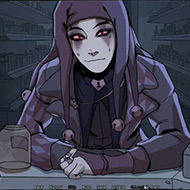
Jecka starts as Nicole’s foil, present in the background of most of the main story’s drama. She eventually becomes central enough to the franchise to headline her own entry, and even inside the base game her scenes carry a different energy than Nicole’s — less openly cruel, more reactive to whatever chaos Nicole causes around her.
The base game tracks toward one of fifteen endings, all shaped by the cumulative pattern of choices rather than a single late-game decision. That number matters for how the game is actually played: because no single choice locks you into an ending early, most players end up replaying specific stretches of the story just to see how one different manipulation ripples outward.
Outfits function as a smaller collectible layer on top of the ending count — over a hundred spread across roughly two dozen characters — rewarding players who dig through side content rather than racing straight through Nicole’s main arc.
The Re-Up shifts focus toward characters who stayed in the background during the original senior year, giving side players like Ari and Kylar routes substantial enough to stand next to Nicole’s own story. Its pacing trades some of the base game’s density of decision points for longer, more developed individual routes, which changes the rhythm of play even though the underlying choice-driven structure stays familiar.
The Flip Side swaps the driver’s seat to Jecka and pulls back the curtain on parts of her home life the base game only hinted at. It’s noticeably heavier — abuse and exploitation sit much closer to the surface than anything Nicole’s storyline directly shows — and it ships with the smallest ending count in the franchise at five, a deliberate narrowing that some players read as thematically appropriate and others read as a loss of the series’ signature player agency.
That split in reception is worth taking seriously rather than smoothing over. Fans who came to the franchise for dark comedy sometimes bounce off The Flip Side’s more sustained seriousness, while fans invested in Jecka specifically tend to defend it as the found the series was always circling.
Puzzle Showdown drops the visual-novel structure altogether in favor of competitive tile-matching, reusing the cast and setting as a backdrop rather than a narrative vehicle. It’s the clearest sign the franchise doesn’t consider itself locked to one genre, even if it means the “dating drama” hook that built the series’ identity is nowhere in this particular entry.
The base Class of ’09 story functions as the clearest entry point, since The Re-Up and The Flip Side both assume familiarity with characters and relationships established during Nicole’s senior year. Puzzle Showdown is the one exception, playable independently of story progress.
The writing frames her that way deliberately — Nicole isn’t a misunderstood good girl underneath the sarcasm, and the game repeatedly declines the chance to redeem her, which is part of why the tone reads closer to dark sitcom than earnest romance.
It depends on what drew you to Nicole’s story. Players expecting the same rapid-fire dark comedy sometimes find The Flip Side’s focus on Jecka’s abusive home life a harder, slower watch, while players interested in the franchise’s dramatic range tend to rate it among the strongest writing in the series.
Class of ’09 never asks you to like Nicole, and that’s precisely the joke it keeps making across every spin-off — a senior year told by someone who treats other people’s feelings as a resource, in a franchise willing to keep following that idea into darker and stranger places with every new entry.

There are no reviews yet. Be the first one to write one.
 Optimized by Seraphinite Accelerator