 (1 votes, average: 5.00 out of 5)
 Loading...
Fullscreen

















![Hello Kitty [HORROR]](https://gamefyno.com/wp-content/uploads/2025/03/hello-kitty-horror-1.jpg "Hello Kitty [HORROR]")
 (1 votes, average: 5.00 out of 5)Loading...
 You tap the arrow key a beat too late, the ball clips a platform that isn’t green, and a run that had been going perfectly for thirty seconds ends without warning. Slope Tunnel doesn’t give second chances mid-run, and that instant, total restart is exactly what keeps people opening the tab again right after a failed attempt.
| Genre | 3D arcade platform runner |
| Platform | Web browser (HTML5, Unity WebGL) |
| Developer | Faramel Games |
| Core Mechanic | Steering a ball across green platforms at speed |
| Controls | Left and right arrow keys |
The entire game hinges on a single restriction: your ball can only land on green platforms. Touch anything else — a different colored platform, a gap, an edge — and the run ends on the spot, sending you straight back to the beginning. There’s no partial credit for how far you made it and no forgiving grace period after a bad landing.
This single rule is what makes Slope Tunnel feel so much tenser than a typical endless runner. You’re not managing health or lives. You’re managing a binary outcome on every single jump, which is a very different kind of pressure than most arcade games ask of you.
It’s also deceptively simple to explain and genuinely hard to internalize under pressure, since the moment your run gets fast enough, distinguishing a green platform from a similarly lit non-green one becomes its own skill.
Because the ball travels at genuinely intense speed, reacting to a platform as you see it is usually already too late. Players who last the longest are the ones who’ve trained themselves to read the maze a beat or two ahead, using the shape and angle of the upcoming section to predict where the next green platform will be before it’s fully on screen.
That anticipation is the real skill the game is testing. The left and right arrow keys themselves are simple, but using them a fraction of a second before you consciously register the next jump is what separates a run that ends in ten seconds from one that stretches past a minute.
Newer players tend to fixate on the platform directly under the ball. Regulars keep their attention a full section ahead instead, treating the current jump as already decided and using their focus on whatever’s coming next.
Slope Tunnel’s 3D perspective is part of the challenge rather than just presentation. Because the camera trails slightly behind and above the ball, depth can be genuinely hard to judge on tight turns, and a platform that looks reachable can actually be a half-step short. This is one of the more common reasons a run that felt fully in control ends abruptly on what looks, in the moment, like a clean landing.
Experienced players adjust for this by favoring slightly earlier inputs on sections where the tunnel curves sharply, giving themselves a small margin instead of trusting the camera’s exact framing.
Scattered dots along the path do two things at once: they add to your score, and they reduce your movement speed. That second effect is easy to overlook when you’re focused purely on chasing a high score, but grabbing a dot right before a particularly tight sequence of jumps can be the difference between clearing it cleanly and clipping a platform you’d normally make with room to spare.
Some players deliberately route toward dots specifically to manage difficult sections, treating them less like bonus points and more like a temporary safety tool. Others ignore them almost entirely and lean into the higher speed, arguing that a faster run is more exciting even if it’s statistically riskier.
Slope Tunnel doesn’t introduce new obstacle types as you go — it simply speeds everything up and tightens the margin for error. Early sections give you a comfortable read on upcoming platforms. The longer a run continues, the less time you have between spotting a platform and needing to commit to it, until the game is effectively testing pure reaction speed rather than planning.
This creates a distinct difficulty curve compared to games that add mechanics as you progress. In Slope Tunnel, the challenge is always the same rule under increasing time pressure, which some players find purer and others find repetitive by the two-minute mark.
The lack of any mid-run recovery is the game’s most divisive feature. Some players consider it the entire appeal — a pure test of reflexes with zero cushioning. Others find the instant, total restart frustrating on longer runs, especially when a strong ninety-second attempt ends on what feels like an unlucky camera angle rather than a genuine misread. Both reactions are common in the community, and the developers have kept the rule exactly as strict as it’s always been.
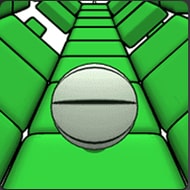
You steer a continuously moving ball using the left and right arrow keys, keeping it on green platforms as the tunnel curves and speeds up. Touching anything other than a green platform ends the run immediately and sends you back to the start.
The dots are built as a dual-purpose pickup — they add to your score while temporarily reducing speed, giving you a brief window of easier control right when a tricky section is coming up. Skilled players use them tactically rather than just for the points.
No. Slope Tunnel doesn’t include checkpoints or health, so any contact with a non-green platform or a gap ends the run instantly. The only strategy is prevention — reading ahead rather than reacting in the moment.
Slope Tunnel doesn’t try to disguise how simple its core rule is, and that simplicity is exactly the point. Every run against those green platforms is a clean test of how far your reflexes can carry you before one wrong tap sends you back to the start.


There are no reviews yet. Be the first one to write one.
 Optimized by Seraphinite Accelerator