 (No Ratings Yet)
 Loading...
Fullscreen










![Hello Kitty [HORROR]](https://gamefyno.com/wp-content/uploads/2025/03/hello-kitty-horror-1.jpg "Hello Kitty [HORROR]")
 (No Ratings Yet)Loading...
 You slide Roman Stilnsky’s file across your desk, hold his ID Badge up next to his face, and compare the eye color printed on the paper against the eyes standing in your doorway. They’re close. Not quite right. That half-second of doubt is the entire tension That’s Not My Neighbor runs on, night after night, folder after folder.
| Genre | Inspection horror puzzle |
| Core Mechanic | Cross-reference visitors against resident files to catch doppelgangers |
| Setting | A 1955 apartment building lobby |
| Modes | Campaign, Arcade, Nightmare, and Custom |
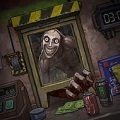
Every shift in That’s Not My Neighbor puts you behind a lobby desk with three tools: a Daily Visitor List telling you who’s expected, a stack of resident file folders describing what they should look like, and a verification Checklist you fill in before making a call. Visitors line up outside, hand over an ID Badge, and wait while you decide whether to let them through or turn them away as an impostor.
The building’s residents form a recurring cast you get to know shift by shift — Roman and Lois Stilnsky, twin siblings Elenois and Selenne Sverchzt, Robertsky and Albertsky Peachman, Arnold and Gloria Schmicht, Izaak Gauss, Margarette Bubbles, Nacha and Anastacha Mikaelys, Mia Stone, Francis Mosses, and the unsettling Dr. W. Afton among them. Twins and paired siblings like Steven and Mclooy Rudboys or Alf and Raftellyn Cappuccin exist specifically to make the file-matching harder, since two similar faces sharing a surname invite careless mistakes.
Doppelgangers rarely announce themselves. The tells are small and inconsistent from visitor to visitor — a seam of stitching along the neck, a faint discoloration around the eyes, an eye color that doesn’t match the resident file, or, on a bad night, an extra arm barely visible under a coat. None of these show up automatically; you have to actually look, which is what separates a clean shift from one where a resident gets replaced on your watch.
When something feels off, the in-office phone lets you call the real apartment directly and ask the visitor questions only the genuine resident would answer correctly. It’s slower than a snap decision, but it’s also the only way to confirm suspicion instead of guessing, and a handful of players specifically chase down the achievement tied to catching a doppelganger red-handed through that phone call rather than rejecting them on instinct alone.
Campaign mode carries the closest thing to ongoing structure, escalating shift by shift as new residents and new doppelganger tricks get introduced. Arcade strips that structure down to faster, standalone shifts for players who want the inspection loop without narrative pacing. Nightmare turns up every dial at once — subtler tells, stricter time pressure, harsher penalties for a wrong call — and is consistently cited as a different game entirely once you’ve only played Campaign. Custom Mode hands the dial settings to the player directly, letting you build a shift tuned to whatever specific challenge you’re chasing.
Nobody who plays That’s Not My Neighbor for more than an hour misses the resemblance to classic border-inspection games — a desk, a stack of documents, a queue of people who may not be who their paperwork claims. What this game adds is the doppelganger angle specifically, turning document-checking into something closer to a supernatural stakeout than a bureaucratic chore, even though the core loop of match-the-paperwork-to-the-face stays the same.
The most common criticism aimed at the game is that once you’ve memorized the resident roster, the tension the doppelganger tells were supposed to create starts to fade. Recognizing Izaak Gauss or Margarette Bubbles on sight makes their file folder redundant, and without a strong ongoing narrative pulling you from shift to shift, several players describe the mid-to-late Campaign as a grind rather than a mystery. Nightmare mode is often recommended specifically as a fix for that fatigue, since it forces re-examination of details regular players stop checking.
What keeps players coming back to That’s Not My Neighbor isn’t really the doppelgangers themselves — it’s the low-grade dread of a routine that only stays routine until one familiar face, Roman Stilnsky’s or anyone else’s, doesn’t match its own file quite right.

There are no reviews yet. Be the first one to write one.
 Optimized by Seraphinite Accelerator