 (No Ratings Yet)
 Loading...
Fullscreen












![Hello Kitty [HORROR]](https://gamefyno.com/wp-content/uploads/2025/03/hello-kitty-horror-1.jpg "Hello Kitty [HORROR]")
 (No Ratings Yet)Loading...
 You strap on the tablet, glance at the ventilation gauge, and hear a metallic shuffle two rooms over that wasn’t there thirty seconds ago. That sound is the entire premise of Five Nights At Freddys 3, a horror game built around a single question: is the shuffling getting closer, or is it just another phantom messing with your systems.
| Setting | Fazbear’s Fright: The Horror Attraction |
| Threat | Springtrap |
| Core Tool | Audio lure device |
| Shift Length | 12am to 6am, five nights plus Custom Night |
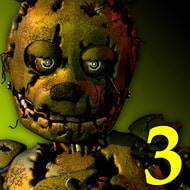
Thirty years after the original restaurant closed, a new attraction called Fazbear’s Fright opens on the legend of what happened there. Somewhere inside its walls is Springtrap, a spring-lock rabbit suit that has been sitting in storage for three decades with something rotting inside it. Unlike the roaming cast of the earlier restaurant, Five Nights At Freddys 3 strips the threat down to one animatronic, and that single-suspect design changes how the whole night plays out.
Springtrap doesn’t sprint across rooms the way earlier animatronics did. He shuffles, slowly, through vents and hallways, and your main defense is an audio lure device that plays a sound in whichever room you pick, pulling him toward the noise and away from your office. Get the timing wrong and you’ll hear him climbing into the vent directly above your head, which is the moment most new players stop breathing.
The tension here isn’t about outlasting a swarm, it’s about reading one opponent’s slow, deliberate approach and constantly asking whether the shuffle you just heard means he’s three rooms away or standing in the doorway. Community shorthand for this loop is simply “luring,” and most guides for the game are built entirely around lure timing rather than power management, since power was the main resource in earlier entries.
Alongside Springtrap, Fazbear’s Fright is haunted by phantom versions of older characters: Phantom Freddy, Phantom Chica, Phantom Foxy, Phantom Balloon Boy, Phantom Mangle, and Phantom Puppet. None of these can end your shift outright, but each one sabotages a specific system when it appears, and figuring out which phantom broke what is half the early learning curve.
Phantom Puppet shows up in the vent camera and can knock out your entire system at once if you don’t reboot fast enough. Phantom Chica lingers in the kitchen feed and corrupts your audio devices. Phantom Freddy causes static across the camera monitor, and Phantom Mangle delivers a jumpscare on the monitor itself that, while not lethal, forces a reboot you didn’t budget time for. Newer players tend to panic-reboot everything at once; players who’ve logged real hours learn to reboot only the system that’s actually flagged as errored.
Underneath the camera feed sits a maintenance panel that reboots audio, video, and ventilation separately, and understanding this panel is what actually separates a five-minute run from a full shift. Ventilation is the one that punishes ignorance hardest: if it stays offline too long, the office overheats, and an overheated office is one of the fastest ways to lose track of where Springtrap actually is, since the sound cues start to lag.
Early in the game most players ignore ventilation status until it’s already critical, then reboot everything at once and eat several seconds of total blackout while every system restarts, which is exactly when Springtrap tends to close the gap. By night 4, the ventilation habit either clicks or it doesn’t, and that’s usually the difference between finishing a night comfortably and finishing it on your last breath.
Scattered through the nights are brief 8-bit static minigames that interrupt the camera feed without warning. They look like a glitch the first time you see one, but they’re the only place Five Nights At Freddys 3 actually tells its backstory, walking through the Purple Guy’s role in what happened to the missing children years earlier and, eventually, how he ends up sealed inside the Spring Bonnie suit that becomes Springtrap.
Completing every minigame across a full playthrough unlocks a different final cutscene than the one you get from just clearing Night 5, and players who only ever play for the jumpscares often never see it. It’s a quiet piece of design: the horror is the thing you show up for, but the actual point of the game is buried in glitchy sprite sequences most people click through by accident.
Once Night 5 is done, Custom Night unlocks sliders for Springtrap’s AI along with a handful of challenge presets built around specific phantom combinations. This is where the game’s biggest community argument lives: a lot of longtime players felt the base five nights were noticeably easier than the equivalent stretch of the previous games, precisely because there’s only one physical threat instead of four or five characters converging on your doors at once.
Custom Night is the counterargument to that criticism, since cranking Springtrap’s AI to maximum while stacking phantom interference turns the same mechanics into something considerably harder than anything in the standard nights. Whether you think the base game is too forgiving or think that’s the point, since Fazbear’s Fright is supposed to be an attraction opening for regular customers, is a debate that still shows up in comment sections.
New players consistently make the same two mistakes. First, they lure Springtrap toward a room without checking whether he’s actually near a hallway camera that can register the sound, wasting the cue entirely. Second, they treat every phantom sighting as an emergency requiring an immediate full reboot, which burns time and leaves systems briefly dark right when Springtrap is closest.
If Springtrap makes it all the way to your office without being lured or rebooted away in time, you get a jumpscare and the shift ends immediately, forcing a restart of that night from the beginning. There’s no partial damage system here; once he’s in the doorway, the run is over.
The real ending requires finding and completing every static minigame across a full playthrough rather than just surviving Night 5. Each minigame reveals another piece of the Purple Guy’s story, and only after all of them are cleared does the final cutscene change to the true ending sequence.
Phantoms exist to drain your attention and force reboots at inconvenient moments rather than to end your shift directly. Phantom Puppet in particular can crash multiple systems at once, and the resulting blackout is often what lets Springtrap close the distance while you’re rebooting blind.
Five Nights At Freddys 3 trades the earlier games’ juggling act for something narrower and, in its own way, more unnerving: one suit, one shuffle, and a maintenance panel that punishes hesitation more than it punishes mistakes. Whether you come for Springtrap’s slow approach or for the static minigames buried in the walls of Fazbear’s Fright, the shift doesn’t end until 6am says it does.


There are no reviews yet. Be the first one to write one.
 Optimized by Seraphinite Accelerator