

 (No Ratings Yet)
 Loading...
Fullscreen
















 (No Ratings Yet)Loading...
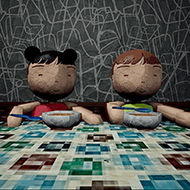
The Zibbo Show looks like a cheerful retro television programme but plays like a tense dice duel where one careless placement can wipe out a column you spent several turns building. You and your opponent each get a 3×3 board and nine dice, you bet before every match, and the studio audience cheers either way. Behind the bright lights the stakes are darker than they first appear, which is exactly the tone that gives this roguelike deckbuilder its bite.
| Genre | Roguelike deckbuilder with dice duels |
| Board | 3×3 grid and nine dice per side |
| Run length | 12 rounds ending with Zibbo himself |
| Collectibles | 48 cards to discover across runs |
Each side owns a 3×3 board and nine dice, and the two of you take turns placing one die at a time. Dice with matching values in the same column multiply that column’s score, so the whole game becomes a question of which column to commit to and when. A die that looks mediocre on its own can turn into the best placement on the table once it sits beside a copy of itself. Players who know Knucklebones will recognise the column logic at once, although the roguelike layers around it make every duel feel different.
Early placements matter more than they look. The first few dice you place tend to set the shape of the whole duel.
Nine dice and nine slots mean a full board arrives quickly, so there is no room for dead turns. Greedy players who chase one tall column will win big when the dice cooperate and lose just as hard when they do not.
Scoring is only half of each duel, because placing the right dice opposite your opponent’s column destroys their dice. That makes their board a target as much as your own, and a column they built over several turns can vanish after one well-aimed placement. Careful players keep one eye on matching values across the gap before committing a die. The crowd roars either way, but the person on the wrong end of a wiped column rarely enjoys the applause.
That risk of losing dice changes how you read every turn. A high-scoring column sitting across from a ready answer is a liability.
Defensive players will love the moment a clever placement erases an opponent’s plan, while aggressive players prefer to chase scoring first and clean up afterwards. Both approaches work, which is why the duel stays interesting even when the numbers do not roll your way.
Before every match you place a bet, and the rule is brutal in its simplicity. Win the duel and the bet doubles, lose and it is gone. That turns the pre-match moment into a small risk calculation, since the confident choice against an early opponent is not always the right one against someone further along the show. Because the opponents get more dangerous as the rounds climb, the right bet in round two is rarely the right bet in round ten.
Confidence and caution both have a price. Pick the one your current build can afford.
Risk takers will stack their bets and trust a strong build to carry them, while careful players keep wagers small until the cards start working together. Neither style is wrong, but the bet is the part of a run where a single decision can feel the loudest.
Cards. Between matches the shop lets you collect cards that trigger automatically during duels, and they stack in ways you do not always see coming. When the right pieces line up, the score jumps in a way that feels very good.
Dice upgrades. The shop also lets you upgrade your dice, so a build can lean on stronger dice instead of luck alone. Optimisers will spend most of their thinking time here, deciding which dice deserve the money.
Chips. Chips are sold in the shop as well, so every visit means choosing what to buy and what to leave behind. Once the cards start stacking, those small choices are what separate a decent run from a huge one.
A run is twelve rounds long, and each round puts you against an opponent more dangerous than the last. Beat them all and you face Zibbo himself in the grand finale, if you make it that far. Early in the run the margin for error is wide, but by the time you reach the later rounds one bad bet can end the whole attempt. Every run is a fresh build, so the route to the finale is never quite the same.
Lose a duel and the show offers a second chance. That is the job of the Spin of Luck.
A Spin of Luck ticket gives you another shot at the same opponent, and it lets you revisit the shop and adjust your build before trying again. Cautious players treat the ticket as insurance, while risk takers spend freely and hope they never need it.
Every run unlocks new cards and new combinations, and there are 48 cards to collect across runs, so there is always something you have not seen. Completionists will chase the full set, while experimenters will enjoy testing a pairing just to watch the score explode. The retro look, the grinning host and the roaring audience hide a darker mood that never quite goes away, which keeps even a lucky run slightly uneasy.
Not everyone will love the dice. Players who dislike randomness will find the swings frustrating, and the shop and the Spin of Luck only soften that rather than remove it.
Even so, the loop is easy to restart. A failed run still unlocks something, and the next visit to the shop always offers a fresh set of choices.
The Zibbo Show works best when a Spin of Luck ticket, a well-placed column and a risky bet all collide in one duel against Zibbo himself. If you enjoy dice puzzles with a dark sense of humour, that final round is the reason to keep building.


There are no reviews yet. Be the first one to write one.
 Optimized by Seraphinite Accelerator