
 (1 votes, average: 5.00 out of 5)
 Loading...
Fullscreen
















![Hello Kitty [HORROR]](https://gamefyno.com/wp-content/uploads/2025/03/hello-kitty-horror-1.jpg "Hello Kitty [HORROR]")
 (1 votes, average: 5.00 out of 5)Loading...
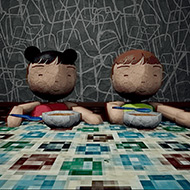
 You are ringing up a regular’s order when she leans over the counter and asks if you’ve heard what happened three houses down. That’s how Narinig Mo Ba? opens: quiet, familiar, and warm enough that you forget to feel uneasy about any of it.
| Genre | Story-driven psychological horror, simulation |
| Platform | Browser (HTML5) |
| Setting | A neighborhood sari-sari store |
| Session length | Short, single-sitting story |
The store is the entire game for the first stretch. You’re the tindera, taking left-click to grab items off the shelf, holding left-click to put something back, and right-clicking to check a price before you hand it over. It sounds mundane, and for a while it is: customers ask for cigarettes, snacks, small change, and you shuffle around a cramped counter trying to keep up with requests that come faster than they should for a corner shop.
Newer players tend to fumble the money math. Someone hands you a bill for something priced at fifty-eight pesos, you’re mentally counting change while also trying to remember which shelf had the item they wanted, and the dialogue keeps scrolling whether you’ve caught up or not. It’s a small stress test disguised as a slice-of-life mechanic, and it works because you’re too busy running a shop to notice the game is quietly building something underneath it.
Players who treat the shift as a checklist tend to miss the point. The store routine isn’t a puzzle to solve efficiently — it’s the thing that lulls you into trusting the neighborhood before the neighborhood gives you a reason not to.
Community vocabulary around Narinig Mo Ba? leans heavily on “the vibe shift,” the moment players say they first noticed something was wrong. It’s rarely a jump scare at that stage — it’s a line of dialogue landing differently the second time a customer says it, or a detail about a neighbor named Junjun that nobody explains outright.
Once the store routine has been established, the game stops resetting to neutral between customers. Sound design does most of the heavy lifting here: the same ambient track that felt cozy in the opening stretch starts to sit slightly wrong, and by the time you reach the late-night shift, silence itself becomes the warning sign.
The horror never fully abandons the shopkeeping loop. You’re still taking items, still checking prices, but the framing around those actions has changed enough that routine tasks start to feel like something you’d rather not be doing alone.
This is also where the store’s left-open-both-ways detail stops being flavor text and starts mattering to how safe the space actually feels.
The most common frustration in Narinig Mo Ba? isn’t the story, it’s the controls. Touchscreen support is limited, so anyone playing on a phone or tablet without a Bluetooth mouse tends to lose items mid-swipe or misjudge how far a shelf object needs to be dragged before it drops correctly. Mouse-first play removes most of this friction entirely.
Beyond input trouble, players commonly rush dialogue to get back to the shelf-stocking loop, which means they miss the small contradictions in what customers say. Those contradictions are the entire mystery.
There’s no publicly confirmed branching chart. The store routine, dialogue choices, and gossip you gather all feed into one central reveal rather than a set of clearly separate paths, so treat any claim of a guaranteed alternate ending with caution.
Right-click on a shelf item to see its price before handing it to a customer. Left-click takes it, and holding left-click lets you return it to the shelf if you grabbed the wrong thing.
No. The opening hours are intentionally calm, cozy, and centered on ordinary shop tasks. Tension builds gradually through sound and dialogue rather than constant threats, so most of the runtime feels closer to a slice-of-life sim than a horror game.
What makes Narinig Mo Ba? stick with people isn’t the scare itself, it’s how long the store made you feel safe first. Somewhere between the counter, the gossip, and whatever actually happened to Junjun, the game trades its cozy premise for something you won’t shrug off on the walk home.

There are no reviews yet. Be the first one to write one.
 Optimized by Seraphinite Accelerator