 (No Ratings Yet)
 Loading...
Fullscreen

















![Hello Kitty [HORROR]](https://gamefyno.com/wp-content/uploads/2025/03/hello-kitty-horror-1.jpg "Hello Kitty [HORROR]")
 (No Ratings Yet)Loading...
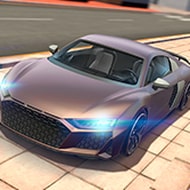
 A single head-on collision in Extreme Car Driving Simulator can turn a pristine hood into a crumpled accordion in under a second, and the game wants you to see every bit of it. There’s no mission timer counting down, no checkpoint nagging you to hurry, just an open city, real damage modeling, and whatever kind of chaos you decide to go looking for.
| Format | Open-world driving sandbox |
| Damage System | Real-time deformation |
| Structure | Free roam, no forced objectives |
| Extra Modes | Traffic mode, drift zones |
Extreme Car Driving Simulator drops you into an open city with almost nothing forcing your hand. There’s no story mission demanding you reach a marker in ninety seconds; the entire appeal is deciding for yourself whether today is a drifting day, a traffic-weaving day, or a day spent finding the tallest ramp in the map and seeing what the landing does to the chassis.
That freedom is exactly what beginners misjudge at first. Without a scoring system pushing them forward, some players bounce off the game in the first few minutes, not realizing the actual draw is the sandbox itself, not a checklist of things to complete inside it.
What keeps players coming back is the deformation system, which visibly crumples panels, cracks glass, and dents body lines based on the actual angle and speed of an impact rather than switching between a handful of pre-baked wreck states. A glancing sideswipe leaves a scraped door; a full head-on hit at highway speed leaves something closer to a compacted block of metal, and the difference between those two outcomes is entirely down to how you drove into it.
Community discussion around Extreme Car Driving Simulator leans heavily on this damage system specifically, with players comparing which cars deform in the most satisfying ways and trading clips of especially dramatic crashes. It’s rare for a mobile driving sandbox to make destruction itself the headline feature rather than a side effect, and that choice is a big part of why the game still gets talked about years after release.
Switching into traffic mode fills the streets with AI-driven cars, turning the open sandbox into something closer to a live obstacle course. Weaving through moving traffic at speed introduces a kind of risk that empty free roam doesn’t have, since a single misjudged gap between two trucks can end a clean run instantly. Advanced players use this mode specifically to practice tight-margin driving before pushing top speeds on empty roads elsewhere in the city.
For players who want something to actually improve at rather than just crash and reset, marked drift zones give Extreme Car Driving Simulator a skill-based layer underneath the sandbox chaos. Chaining a long drift through a corner without spinning out or clipping a wall takes real practice, and it’s one of the few parts of the game with a clear sense of getting measurably better over time.
Whether the appeal for you is the honest crumple of sheet metal, the tension of threading through traffic mode at speed, or the quiet satisfaction of a clean drift through an empty intersection, Extreme Car Driving Simulator keeps its answer the same: there’s no wrong way to spend a session here, only different kinds of wreckage waiting at the end of it.


There are no reviews yet. Be the first one to write one.
 Optimized by Seraphinite Accelerator