 (1 votes, average: 5.00 out of 5)
 Loading...
Fullscreen










![Hello Kitty [HORROR]](https://gamefyno.com/wp-content/uploads/2025/03/hello-kitty-horror-1.jpg "Hello Kitty [HORROR]")
 (1 votes, average: 5.00 out of 5)Loading...
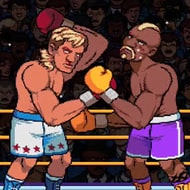
 You throw a jab, follow it with a cross, and your opponent staggers into the stun state. Now comes the real decision: fire the uppercut immediately or wait for a cleaner opening. That choice sits at the center of Big Shot Boxing, a 2D career game where you pick a fighter, hire a coach, and climb the rankings toward the Hall of Fame. Every bout can end by knockout or on the judges’ scorecards, and the game treats both routes as valid.
| Genre | 2D career boxing |
| Goal | Climb the rankings and reach the Hall of Fame |
| Punches | Jab, cross, uppercut |
| Ways to win | Points decision or knockout |
| Trainable skills | Health, power, chin, recovery |
The fighting system rests on three punches and one defensive move. The jab probes, the cross commits more weight, and the uppercut is the finisher you save for a hurt opponent. Block is the fourth tool, and the game quietly rewards players who treat it as a weapon rather than a panic button, because a raised guard buys you time to read what is coming next.
The stun state ties everything together. Damage accumulates over a round, and once your opponent has taken enough, a clean combination leaves them dazed and open to a big blow. Throwing the uppercut into a healthy opponent is the most common way to waste that window, since the punch only pays off when the guard is already broken.
Timing matters more than volume here. A patient counterpuncher who blocks first and answers back will usually out-land a fighter who swings on every beat.
Early in your career the opponents are forgiving, and that teaches bad habits. New players hammer the punch keys, ignore block because it feels passive, and still win against the first few names on the ladder. The trouble arrives as the rankings climb, when the same habits start trading punches evenly, which is exactly how you lose a fight on points while feeling busy the whole time.
The second mistake is forgetting that the judges score round by round. A frantic flurry at the bell does not erase a round you spent covering up, and a knockout hunter who chases the finish at all costs can hand the scorecards to the other corner. Clean punches beat many punches.
The third mistake is under-training. Your fighter has four trainable skills, and players who rush from bout to bout without upgrading them tend to hit a wall a few rungs up. Then they blame the controls instead of the stat sheet.
Training is where career mode becomes a long game instead of a string of separate fights. Between bouts you shape your boxer through four skills, and each one changes how fights feel in a different way.
Many experienced players lean on chin and recovery first. The glass chin is the classic complaint, a fighter who looks strong on paper but folds after one clean hit, and no amount of power makes up for that.
Power-heavy fighters are tempting because knockouts feel great, but they leave you exposed on the scorecards if the opponent survives. Balance tends to win over the length of a career, though players who love min-maxing will still find room to specialize as long as they accept the trade-offs.
Because judging happens round by round, you can win without ever landing the big shot. Plenty of players go to the cards on purpose: block, counter, bank rounds, and collect the decision. It is less flashy than a knockout, but it is a real strategy that the game fully supports.
Getting knocked down changes the fight. When you go down you have 10 seconds to recover, and that count is a genuine second chance rather than a formality. Recovery, one of the four trained skills, is the natural companion to the count, so investing there gives you more room when a bout turns bad.
What stays with players is the moment on the canvas, with the count running and the fight suddenly a matter of nerve instead of skill. It is the point where a comfortable lead on the scorecards can vanish.
Your fighter ages. Over a career the boxer declines, and retirement stops being a distant idea and becomes something you plan around. This is the most divisive part of the game: some players love the stakes, while others feel punished after investing so much time in a fighter they cannot keep forever.
Titles change the rhythm. Once your fighter holds a belt, the goal shifts from climbing to defending, and the achievements reward exactly that, with unlocks for winning matches, gaining titles, and defending them. Completionists will find that the achievements give every fight a second purpose beyond the ladder.
The money you earn also goes into changing your fighter’s gloves, shorts, and boots. It is about appearance rather than power, but it gives a long career some personality. By the time you approach the Hall of Fame, your boxer looks like yours and nobody else’s.
Build damage with jabs and crosses until your opponent enters the stun state, then land the uppercut while the guard is open. Rushing the finisher into a healthy opponent rarely works, so keep your own block up and wait for the opening.
Chin is one of the four trainable skills, alongside health, power, and recovery, and it governs how well your fighter withstands heavy shots. A weak chin is the classic glass chin problem, where a single clean hit sends a strong fighter to the canvas and starts the 10-second count.
Yes, because your fighter ages over the career and declines with time. That makes it worth chasing titles and the Hall of Fame while your skills are at their peak, instead of coasting on early wins.
Big Shot Boxing works because a single stun state can flip a round, a ten-second count can flip a fight, and a coach’s training plan can flip a career. Learn to block before you swing, put your points into chin and recovery before power, and the road to the Hall of Fame stops feeling like luck.


There are no reviews yet. Be the first one to write one.
 Optimized by Seraphinite Accelerator