

 (No Ratings Yet)
 Loading...
Fullscreen
















 (No Ratings Yet)Loading...
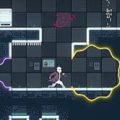
20 More, Somehow Even Smaller, Mazes looks like a throwaway pack of tiny puzzles but plays like twenty separate arguments with the idea of a maze. Each stage keeps the goal simple, getting the dot to the exit, and then quietly changes what the maze is allowed to be. A layout you can read in three seconds can still hold you up for ten minutes once its trick shows itself. That gap between how small these mazes look and how stubborn they behave is the entire hook.
The first thing the game does is hand you a stack of mazes on your desktop. Nothing waits behind a menu, so all twenty sit there at once and you can drag them around until one catches your eye. If a maze beats you, you simply push it aside and try another, which keeps the run relaxed even when a particular puzzle gets under your skin. It is a smart structure for a collection this short, because frustration never has a wall to hit.
This is the sequel to 20 Small Mazes, and it makes a point of not requiring the original. You can start here without any homework, and the only thing you carry over is the habit of distrusting a maze that looks too easy. Anyone who has played a thinky puzzle collection before will recognize the rhythm: tiny rooms, one idea each, and no hand-holding.
Expect an hour or so for the full set, which works out to roughly three minutes per maze on average. That average hides a lot of variance. Some mazes fall in under a minute while one stubborn stage can swallow a quarter of your whole session.
Most newcomers treat every stage as a pathfinding problem. They trace routes with the dot, hit a wall, back up, and trace again, when the stage is really asking a different question. In a collection where each maze brings its own element, the route is often the least interesting part of the puzzle.
The same few habits cost players the most time in the opening mazes. Spotting them early saves a surprising amount of frustration.
Completionists tend to grind a single stage until it gives way, and that is usually the slower route. Stepping away to a different maze and coming back later is not cheating here, since the desktop layout practically invites it. Puzzle veterans will find the pause does half the solving.
The best moments come when a maze quietly breaks a rule you did not know you were assuming. In one stage the maze bursts into separate pieces, yet the dot can still travel through it no matter where on the screen those pieces end up. Another stage leaves the dot where it sits and lets you drag the maze instead, so you end up pushing the dot toward the exit. A third turns out smaller than its own name promised, which is the kind of joke only this series would risk.
Once a maze falls apart, spatial instincts stop being reliable, and that is where the game earns its reputation. You learn to ask what is actually connected rather than what merely looks connected. The payoff is a small private click of understanding, and the stage is over almost the moment you get it.
Difficulty is uneven by design. By the time you have dragged a few mazes around the desktop, you start suspecting every stage of hiding some movable part, and the suspicion itself becomes a tool. Are the mazes hard? Not in a punishing sense, but they are stubborn, and one stage can feel unsolvable for ten minutes and obvious for ten seconds afterward.
Reception has been loud. The sequel sits at 99% positive on Steam across more than 2,000 reviews, which is rare for any puzzle release, and some reviewers say they would gladly have paid for it.
The honest complaint is length. An hour or so ends before many players are ready to stop, and anyone hoping for a long puzzle campaign will reach the last maze early. Fans call that tightness, while others would trade a few mazes for a few more hours, and both camps have a point.
How long is it, then? About an hour for a first clear, though nothing stops you from dragging a favorite maze back out afterward. Do you need to play the earlier collection first? No, since coverage of the sequel states plainly that the original is optional, so you can start with the desktop pile and decide later.
20 More, Somehow Even Smaller, Mazes is at its best when the dot refuses to behave the way the maze promised and you realize the stack on your desktop was teaching you to doubt your own eyes. Drag a maze out, trust nothing, and expect to be wrong at least once before the exit appears.


There are no reviews yet. Be the first one to write one.
 Optimized by Seraphinite Accelerator