 (1 votes, average: 5.00 out of 5)
 Loading...
Fullscreen











![Hello Kitty [HORROR]](https://gamefyno.com/wp-content/uploads/2025/03/hello-kitty-horror-1.jpg "Hello Kitty [HORROR]")
 (1 votes, average: 5.00 out of 5)Loading...
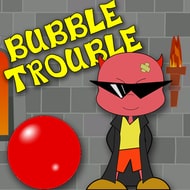
 The harpoon in Bubble Trouble never runs out, but that’s the only forgiving part of the entire game. Every bubble you pop splits into two smaller, faster ones, and the only way to actually clear a stage is by shrinking bubbles down until there’s nothing left to split — a mechanic simple enough to explain in one sentence and difficult enough to master over dozens of attempts.
| Genre | Arcade action |
| Platform | Browser, mobile, console |
| Structure | 22 levels of increasing bubble density |
| Core Objective | Clear every bubble on screen without getting hit |
You control Mr. D, moving left and right along the ground while aiming the harpoon straight up to pop whatever bubble happens to be overhead. Land a shot on a large bubble and it doesn’t disappear — it splits into two smaller bubbles that immediately bounce off in different directions, each one faster and harder to predict than the one you just hit.
This splitting behavior is the entire skill test of Bubble Trouble. A screen with one slow bubble is trivial. A screen with four small, fast bubbles bouncing at odd angles because you popped things in the wrong order is a completely different problem, and it’s one you create for yourself with bad shot sequencing.
Getting touched by any bubble, no matter how small, costs you the stage, which means the final, tiniest bubbles left on screen are often more dangerous than the large ones you started with, simply because there’s nowhere left to retreat to once the game narrows your options.
Bubbles in Bubble Trouble bounce off the floor and walls at predictable angles, and reading those angles ahead of time is what separates a clean level clear from a frantic scramble. Shooting a bubble while it’s rising rather than falling changes where its two halves end up, and experienced players plan their shot timing around that split trajectory rather than just aiming at whatever’s closest.
Early in the game, with only one or two bubbles on screen at once, this barely matters. Once a level throws multiple large bubbles in at the same time, mistimed shots start compounding — pop the wrong bubble first and you can end up boxed into a corner by the smaller bubbles it left behind.
Players in the community sometimes call this “chain-popping,” clearing a bubble’s full split sequence quickly before it has time to bounce into an awkward position, rather than picking off smaller bubbles one at a time as they scatter.
By the time you reach the back half of the level set, clearing a stage often comes down to picking one “safe” bubble to leave for last and controlling the chaos of everything else first — a decision that looks nothing like the simple pop-and-move strategy the early levels teach.
Playing solo rewards patient positioning, since every mistake is yours alone to fix. Bringing in a second player for local co-op changes the calculus entirely — now you’re managing your own dodging while also avoiding a teammate’s harpoon shots and bubble splits crossing into your space, which some players find genuinely harder than playing alone despite having twice the firepower on screen.
Casual players tend to gravitate toward the two-player mode purely for the chaos of it, while score-focused players almost always default back to solo runs where positioning is fully within their own control. How do you actually avoid getting cornered by your own splits in Bubble Trouble? Most experienced players will say it comes down to always leaving yourself an escape lane before firing, rather than reacting to the split after it’s already happened.
One thing players consistently agree is rough around the edges: the final few bubbles on a crowded stage can move erratically enough that a clean, foreseeable loss occasionally feels more like bad luck than a punished mistake — a fair criticism of a game that otherwise rewards precise play.
Bubble Trouble doesn’t need more than a harpoon and a wall of bouncing targets to stay compelling across all 22 levels, because the splitting mechanic alone generates enough chaos to keep every stage feeling different from the last. Whether you’re playing Mr. D solo or juggling a second harpoon in co-op, the tension always comes back to that same unforgiving rule: one touch from any bubble, big or small, and the run is over.

There are no reviews yet. Be the first one to write one.
 Optimized by Seraphinite Accelerator