 (1 votes, average: 5.00 out of 5)
 Loading...
Fullscreen














![Hello Kitty [HORROR]](https://gamefyno.com/wp-content/uploads/2025/03/hello-kitty-horror-1.jpg "Hello Kitty [HORROR]")
 (1 votes, average: 5.00 out of 5)Loading...
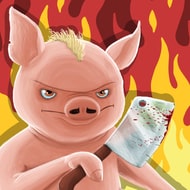
 Iron Snout looks like a cartoon about a pig punching wolves, and on the surface that’s exactly what it is — but the game plays more like a reflex test than a fighting game, and it punishes hesitation harder than almost anything in its genre.
| Genre | Beat ’em up / fighting |
| Core Mechanic | Directional punches, kicks, and projectile deflection |
| Objective | Survive and defeat as many wolves as possible |
| Controls | Arrow keys for movement, jumping, and attacks |
There’s no combo list to memorize here. Iron Snout runs entirely on directional inputs — the arrow keys double as punch, kick, jump, and duck, and the game reads your timing rather than your button sequence. A wolf lunging from the left gets punched by pressing left into it; a low attack gets ducked; a thrown axe gets knocked back with the right timing on a kick. It sounds simple written out, and it is, but the pace at which wolves spawn means simple doesn’t mean easy for long.
What separates a good run from a short one isn’t reaction speed alone — it’s reading which direction the next threat is coming from before it arrives on screen. Wolves attack from both sides, sometimes simultaneously, and a player locked into fighting the one on the right gets blindsided by the one closing in from the left.
Deflection is the mechanic most new players undervalue. Rather than just dodging thrown weapons like axes or shurikens, timing a kick or punch into them sends the projectile flying back into the wolf that threw it, turning defense into offense without costing any extra time.
The two settings aren’t just backdrops. City and Forest each bring different enemy types and different projectiles into rotation, which means strategies that work cleanly in one world need adjusting in the other. Chainsaws show up more aggressively in one setting, rockets in the other, and players who’ve only practiced against one world’s pattern often get caught off guard the first time the second one loads in.
By the time a run reaches the higher wave counts, both settings start throwing multiple projectile types at once, and that’s usually where even experienced players start losing streaks they’d normally survive.
Classic mode is the default survival grind — waves of wolves, escalating difficulty, no gimmicks. Sudden Death strips away the margin for error entirely, where a single hit ends the run regardless of how far in you were. Wolfieball flips the format into a two-player mode built around knocking a wolf back and forth like a ball rather than straightforward combat, and it’s the one mode that turns Iron Snout into something you’d actually sit down and play with a friend rather than solo.
Most of the community’s high-score chasing happens in Classic and Sudden Death, while Wolfieball gets played more for the novelty of it than for competitive standing.
The recurring complaint in player discussion is that the game can feel like it comes down to reaction time more than skill once wave counts get high enough — spawn patterns start overlapping to a point where even a well-timed deflect doesn’t leave enough recovery window before the next attack lands. It’s not a universal opinion, but it shows up often enough in community talk to count as a genuine sticking point rather than a one-off gripe.
On the other side, plenty of players point to the achievement system and seasonal cosmetics — the Santa-snoutfit being the most recognized one — as reasons runs stay worth replaying even after the core loop starts feeling familiar.
New players often ask why their pig keeps getting hit despite blocking — the answer is usually that ducking and deflecting are direction-specific, so blocking left does nothing against an attack coming from the right, a distinction the game never explains outright and most players only learn by getting hit a few times. Another common question is why Wolfieball feels so different from Classic — it’s because the mode’s scoring is based on keeping the wolf in play rather than eliminating enemies, which changes the entire rhythm of how punches and kicks get used.
Iron Snout doesn’t ask for much investment before it clicks, but the gap between a player who’s played twenty minutes and one who’s logged twenty hours shows up fast once City and Forest start layering their harder patterns together, chainsaw and rocket arriving in the same breath with nothing but a well-timed kick standing between the pig and the next wave.


There are no reviews yet. Be the first one to write one.
 Optimized by Seraphinite Accelerator