 (1 votes, average: 5.00 out of 5)
 Loading...
Fullscreen















![Hello Kitty [HORROR]](https://gamefyno.com/wp-content/uploads/2025/03/hello-kitty-horror-1.jpg "Hello Kitty [HORROR]")
 (1 votes, average: 5.00 out of 5)Loading...
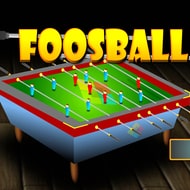
 Foosball looks like a straightforward table-football sim you’ll master in an afternoon, but the timing window on a real striker shot is tighter than most players expect going in.
| Genre | Sports simulation |
| Players | 1 to 4, local and online |
| Core mechanic | Rod control and timed striker shots |
| Table layout | Standard three-rod-per-side foosball configuration |
Foosball’s entire skill ceiling comes down to three rods per side — the goalkeeper rod, the defense rod, and the attacking rod — and how well you can shift between them under pressure. Mouse control lets you slide a rod laterally while holding the shot timing separately, which sounds simple until an opponent’s ball is already crossing midfield and you’re still lined up on the wrong figure. Each rod also carries its own figure spacing, meaning the gaps a ball can slip through on the defense rod are noticeably wider than on the attacking rod, a detail that only becomes obvious after conceding a few goals through what looked like a solid defensive line.
A curved shot off the attacking rod is the single technique most beginners never learn, because the game doesn’t force you to use it early on. Landing one consistently takes real practice with the timing window, since pulling the trigger even a fraction of a second early sends the ball straight into a waiting keeper rather than around it. Bank shots: caroming the ball off the side wall to beat a keeper who’s guessing straight-line trajectory, are one of the first things competitive players pick up once matches against real opponents start punishing predictable strikes.
Players who spend time in Foosball’s practice mode tend to notice something the tutorial never spells out — figure rotation speed differs slightly between rods, with the attacking rod snapping around faster than the goalkeeper rod. That asymmetry is deliberate, rewarding aggressive rotation on offense while forcing more deliberate, measured movement on defense, and it’s part of why the game rewards players who specialize rather than treating every rod identically.
Against the AI, difficulty scales mostly through reaction speed and shot variety rather than any dramatic rule change. Lower difficulties let you get away with slow rod switches; higher ones punish any hesitation on the defense rod almost immediately. By the time you reach the higher tiers, the AI starts mixing in bank shots of its own, which catches players off guard if they’ve only been practicing against lower difficulty opponents who play in straight lines.
Players who came to Foosball expecting a casual sports game often bounce off the higher AI tiers, and that difficulty spike is one of the more debated aspects in community discussion — some see it as necessary challenge that keeps singleplayer relevant after the novelty wears off, others as a steep wall dropped in too early relative to how gently the lower tiers play. It’s a fair criticism either way, and one the developers haven’t fully addressed with difficulty settings that scale as smoothly as players would like.
One detail that separates strong AI matches from weak ones is possession time — the higher difficulties hold the ball on their attacking rod far longer before committing to a shot, forcing you to stay in position rather than lunging for an interception, since a mistimed lunge against a patient AI opponent almost always opens a clean lane to your own goal.
Online play strips away the AI’s patterns and replaces them with human unpredictability, which changes the whole rhythm of a Foosball match. Defensive players lean almost entirely on the goalkeeper and defense rods, content to grind out low-scoring wins by waiting for their opponent to make the first mistake, while aggressive players push the attacking rod constantly and accept the open-goal risk that comes with it. Neither approach dominates outright in the current ranked pool, and that balance is part of what keeps matchmaking interesting rather than solved.
Rallies rarely last more than a few seconds once both players know what they’re doing, and that speed is exactly what keeps ranked Foosball matches from feeling repetitive even after dozens of games. Community players sometimes call a fast back-and-forth exchange a “flurry,” and being able to stay composed through one without losing rod control is generally considered the mark of a genuinely skilled Foosball player rather than just a lucky one.
Can you play Foosball with four people locally on one screen? Yes — the game supports up to four players split across both sides of the table, and it’s one of the more popular ways to play Foosball at all, since two-on-two matches add a coordination layer that solo rod control doesn’t have, with each teammate typically claiming two of the three rods on their side. How long does a typical Foosball match take? Most single matches run five to ten minutes depending on the score cap, short enough that a quick rematch is almost always on the table. Does Foosball reward pure reflexes or is positioning more important? Positioning generally wins out — players who keep their defense rod centered rather than chasing the ball tend to concede fewer bank shots than reflex-focused opponents, since chasing leaves the near-side gap open exactly when a patient opponent is waiting to exploit it.
Foosball earns its place among sports sims by trusting a genuinely simple table to carry the whole experience, and it mostly works because the gap between a beginner’s straight shot and a veteran’s bank shot off the wall is wide enough to keep matches interesting for a long time. Once you’ve learned to stop chasing the ball with your goalkeeper rod and start reading where the attacking rod is aiming instead, Foosball stops feeling like a novelty and starts feeling like a real contest.


There are no reviews yet. Be the first one to write one.
 Optimized by Seraphinite Accelerator