 (1 votes, average: 5.00 out of 5)
 Loading...
Fullscreen











![Hello Kitty [HORROR]](https://gamefyno.com/wp-content/uploads/2025/03/hello-kitty-horror-1.jpg "Hello Kitty [HORROR]")
 (1 votes, average: 5.00 out of 5)Loading...
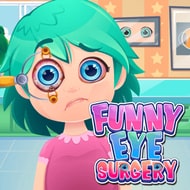
 An eye covered in germs and boogers doesn’t fix itself, and neither does a patient with cataracts clouding their vision — that’s the entire job description in Funny Eye Surgery, where you’re handed the role of an ophthalmologist one exaggerated case at a time.
| Genre | Medical simulation |
| Controls | Mouse to select, drag, and move equipment |
| Objective | Treat each patient’s eyes through cleaning, testing, and styling |
Every patient who sits down starts in rough shape, and the first job is never the surgery itself — it’s cleanup. Using eyedrops to clear germs and stray boogers off the eye is the mandatory first step, and skipping ahead to anything else before the eye is clean tends to make later steps sloppier than they need to be.
It’s a small task, but it sets the tone for the rest of the game: nothing here is instant, and every procedure builds on the one before it. The eyedrop stage also doubles as the calmest moment of each visit, a short beat before the more delicate surgical work begins.
Patients react differently to how thoroughly you clean them. A rushed pass with the eyedrops usually still lets you proceed, but it leaves visible residue that carries into the next stage, which is one of the small details that separates a tidy playthrough from a messy one.
Once the eye is clean, Funny Eye Surgery moves into actual diagnostic work. The vision test checks how well the patient can see, and it’s not just a formality — the result of this test is what decides whether the patient needs cataract treatment at all or can skip straight to the cosmetic stage.
Reading the vision test correctly matters more than it first appears. A patient who doesn’t actually need surgery but gets operated on anyway still technically progresses the game, but it undercuts the point of the diagnostic step, and regulars treat it as a shortcut worth avoiding if you’re aiming for a clean, accurate run through each patient.
Cataract treatment is where most of the careful, drag-and-click precision in the game comes in. It requires more deliberate tool handling than the cleanup stage, and it’s the closest thing Funny Eye Surgery has to a genuine skill test rather than a straightforward click-through task.
The clouded area has to be addressed directly rather than approximately, and rushing through it is the most common way a playthrough goes sideways for new players. Slowing down here, even though nothing in the interface explicitly punishes speed, tends to produce a noticeably cleaner result once the patient moves to the next stage.
Some patients require multiple passes before the treatment reads as complete, and that repetition is intentional — it mirrors the eyedrop stage in making sure no single click resolves the whole procedure at once.
The surgery isn’t the end of the visit. Once a patient’s eyes are treated, Funny Eye Surgery shifts tone completely, letting you pick glasses, stickers, and hats to send them off looking their best. It’s a lighter, low-stakes section compared to the medical steps before it, and it’s also where most of the game’s humor lives — mismatched glasses and silly hats on a freshly treated patient is very much the point.
Some players treat this styling stage as optional flourish and rush through it; regulars tend to slow down here specifically because it’s the reward for getting the medical steps right, and matching accessories to a patient’s exaggerated personality is part of what keeps each visit from feeling identical to the last.
No two patients arrive in quite the same state. Some need heavy eyedrop cleanup and barely any cataract work; others sail through cleanup but need a longer, more careful treatment pass. That variation is what keeps Funny Eye Surgery from feeling like the same three clicks repeated endlessly, even though the underlying steps never really change.
Casual players tend to move through the cleaning and testing stages quickly and spend most of their time on the styling screen, since that’s where the payoff feels most visible. More completionist-minded players slow down at the diagnostic stage instead, treating an accurate vision test as the real measure of a well-played visit rather than the accessories at the end.
The most frequent mistake is skipping straight to cataract treatment before fully cleaning the eye with eyedrops. The game doesn’t always block you from doing this, but it tends to make the treatment step feel messier and slower than it should, since you’re working around debris that should have already been cleared.
Yes — the vision test is what determines whether cataract treatment is even needed for that particular patient, so skipping it means guessing at a diagnosis instead of confirming one.
You can technically move forward, but leftover germs and boogers make the subsequent surgical steps harder to execute cleanly, which is why most guides treat the cleaning stage as non-negotiable.
No, the styling stage in Funny Eye Surgery is purely cosmetic — it doesn’t change scoring or unlock anything beyond the visual send-off for that patient.
Funny Eye Surgery keeps its loop short and repeatable on purpose, and the appeal isn’t really the surgery mechanics themselves — it’s the contrast between the genuinely careful cataract treatment work and the silly, no-stakes moment of picking out a hat right after.


There are no reviews yet. Be the first one to write one.
 Optimized by Seraphinite Accelerator