 (1 votes, average: 5.00 out of 5)
 Loading...
Fullscreen














![Hello Kitty [HORROR]](https://gamefyno.com/wp-content/uploads/2025/03/hello-kitty-horror-1.jpg "Hello Kitty [HORROR]")
 (1 votes, average: 5.00 out of 5)Loading...
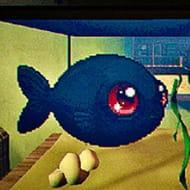
 In FEED THE FISH you start with one task and one object: a small black fish in a tank inside a secluded trailer, and the instruction not to let it starve. The fog outside is already thick when the game opens. The sky is already the wrong color. You have not done anything wrong yet, and that is precisely what makes the next few minutes work as well as they do.
| Genre | PSX psychological horror |
| Platform | Windows |
| Engine | Unreal Engine (PSX Horror Kit) |
| Length | Short-form, single session |
| Meta feature | Creates a .txt file on your desktop during play |
The game is built around repetition with decay. You feed the fish. You look around the trailer. You notice something slightly different from before. Then you feed the fish again. The core mechanic is mundane by design — an interact prompt, a feeding animation, a moment of quiet — and that mundanity is the horror delivery system. Players who rush the interaction looking for a scare miss what the game is actually doing, which is making the ordinary feel increasingly wrong through accumulation rather than event.
The trailer interior is small, and FEED THE FISH uses that constraint deliberately. There are no sprawling areas to explore, no inventory to manage, no combat. Every object in the space is positioned to be noticed. Something shifts between visits — furniture, light, the fish itself — and the game trusts you to register the difference without flagging it. Players who pay attention to the tank during the feeding animation, rather than just clicking through it, tend to catch the earliest signs. That specific moment has become the detail that players most commonly describe when discussing what unsettled them first.
The .txt file the game writes to your desktop is a meta feature that divides players sharply. Some find it the most effective moment in the entire experience — a horror game breaching the space between screen and desk. Others find it intrusive in a way that breaks immersion rather than deepening it. It is worth knowing about before you play, because the surprise was designed to land as part of the narrative, and spoiling it here is preferable to having it alarm you into closing the game before the ending resolves.
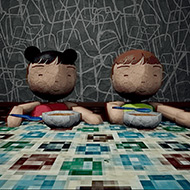
The PSX aesthetic does specific work in FEED THE FISH beyond visual nostalgia. The low polygon count and limited texture resolution make the fish tank harder to read clearly, which makes the moments when something inside it changes more effective than a high-fidelity version would be. You are not sure if you saw what you think you saw, and the visual noise provides plausible deniability. Horror players in the community consistently note that the fish itself — specifically its behavior near the end of the experience — lands harder than any of the exterior fog sequences.
The sound design carries the pace between interactions. The underwater ambient hum present throughout each feeding sequence is unremarkable on first listen. By the third visit to the tank, that same sound has a quality that players describe variously as wrong or too loud, though neither the pitch nor the volume has changed. That kind of perceptual shift, achieved without any technical change to the audio, is the most precise thing FEED THE FISH does. New players tend to notice it only on replay, which is why the community pushes short-form horror fans toward a second session.
Yes, though fewer than the PSX aesthetic might suggest. The most commonly discussed one is tied directly to a feeding interaction rather than to exploration or environmental triggers. Players who went in expecting a walking-simulator experience and were caught off guard by it describe the timing as unusually well-calibrated — it arrives at a moment when the repetition has made you comfortable enough to stop anticipating it.
FEED THE FISH writes a short text file to your desktop as part of its narrative design. It is a plain text document, not an executable, and contains content that functions as an in-world note connected to the game’s ending. It is part of the intended experience and not a bug or a genuine system intrusion. Deleting it after playing has no effect on the game, though some players keep it as part of the experience.
FEED THE FISH works because its fish tank, its one-room trailer, and the small black fish at the center of both are specific enough to mean something by the time the experience ends. The horror is never in the task itself — it is in what the task reveals about what has been sharing that trailer with you the whole time.


There are no reviews yet. Be the first one to write one.
 Optimized by Seraphinite Accelerator