 (No Ratings Yet)
 Loading...
Fullscreen















![Hello Kitty [HORROR]](https://gamefyno.com/wp-content/uploads/2025/03/hello-kitty-horror-1.jpg "Hello Kitty [HORROR]")
 (No Ratings Yet)Loading...
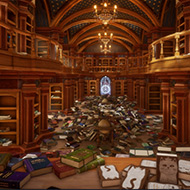
 You step over a knee-high drift of loose pages, spot a matching pair of spines poking out from under a toppled cart, and already know this row is going to take a while. That first minute inside Librarian: Tidy Up The Arcane Library! is the whole pitch in miniature — a library that a mischievous fairy has wrecked from floor to ceiling, and a job that only gets done one shelf at a time.
| Genre | Simulation / Sorting Puzzle |
| Perspective | First-person, 3D |
| Core Task | Shelve 3,072 scattered books correctly |
| Key Systems | Series matching, magic abilities, Principal evaluation |
The core loop never really changes: pick up a book, work out which series it belongs to, carry it to the right shelf, repeat. What changes is how much help the game gives you along the way, since every completed row unlocks a spell that chips away at the tedium. There’s no penalty for going slow in a corner and reading titles, which is part of why so many people describe the game as background noise for a rough day rather than something you sit down to beat quickly.
New players almost always start by grabbing whatever book is closest, and that habit falls apart fast once piles start mixing multiple series together. The smarter approach players settle into is picking one recognizable title, gathering every volume of it from the mess, and placing the full run before moving on — the game rewards that discipline by lighting a shelf blue the moment a row is complete and in order.
The white-cat row near the entrance is where most runs quietly teach this lesson, since it’s small enough to fail safely and learn what “correctly shelved” actually requires. A shelf that refuses to turn blue almost always means one book is out of series order, split from its set, or just missing entirely, and tracking down that single misplaced volume becomes its own small hunt.
Once a player has cleared a few easy rows, four hidden keys scattered through the building start to matter — each one grants a permanent skill like a longer sprint or a higher jump, and finding them early makes the back half of the run noticeably less frustrating. Skipping them isn’t fatal, but it does mean crossing the same floor on foot far more times than necessary.
Three abilities unlock as rows clear, and each one reshapes the pace of the game rather than just speeding up the same actions. Insight highlights every remaining volume of a series a player is currently holding, which turns blind searching into a guided sweep across a pile. Assemble goes further and physically summons the rest of that series straight into a player’s hands, collapsing what used to be several trips into one.
Auto-Shelving is the one most people save for last, since it snaps held books directly onto their shelf in perfect order without manual placement. Used early it can feel like it removes the puzzle entirely, which is exactly why players chasing the Anti-Magic Master style of run tend to avoid it on purpose, relying only on Insight or nothing at all to keep the sorting honest.
The Principal’s evaluation runs in the background the whole time, tracking accuracy against speed rather than either one alone. A fast run full of misshelved rows scores worse than a patient one, and that tension between rushing and getting it right is a big part of why the loop stays interesting past the first hour.
The most common complaint isn’t difficulty — it’s that book positions never randomize between playthroughs, so a second run through the same save structure plays out almost identically to the first. Players who love the atmosphere tend to shrug this off as expected for the genre, while completionists chasing every achievement find themselves repeating the exact same route with little new to discover.
The ambient music draws mixed reactions too. Some players find the dynamic soundscape, which grows richer as more rows fill in, genuinely immersive; others feel it stays thin for a game with this much production polish elsewhere. Neither complaint stops most people from finishing a full playthrough in roughly three to four hours, which lines up with how the pacing is clearly built.
It almost always means a volume from that series is missing, split onto another shelf, or placed out of numerical order — check the row left to right before assuming a book is lost.
It saves real time on later rows, but using it too early removes the sorting puzzle that makes early rows satisfying, so many players deliberately hold off.
Most players finish shelving all 3,072 books in three to four hours, though achievement hunting and the Anti-Magic Master route both add extra time.
Librarian: Tidy Up The Arcane Library! isn’t trying to be a long game, and it doesn’t need to be — the satisfaction comes from watching a chaotic floor near the Principal’s desk slowly disappear under books that finally belong somewhere. Once Assemble is in a player’s toolkit, the whole rhythm shifts from searching to sorting, and that shift is what people keep coming back to describe.


There are no reviews yet. Be the first one to write one.
 Optimized by Seraphinite Accelerator