 (1 votes, average: 5.00 out of 5)
 Loading...
Fullscreen










![Hello Kitty [HORROR]](https://gamefyno.com/wp-content/uploads/2025/03/hello-kitty-horror-1.jpg "Hello Kitty [HORROR]")
 (1 votes, average: 5.00 out of 5)Loading...
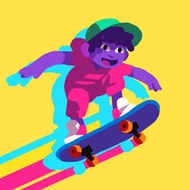
 In We Skate you start with a single skateboard, an empty coin count, and a straightforward run stretching ahead of you — no story setup, no tutorial overload, just timing that either works or doesn’t from the very first jump.
| Genre | Platformer / endless runner |
| Core Mechanic | Timed jumps over obstacles and gaps |
| Objective | Collect coins and clear obstacles without falling |
| Controls | Arrow keys or WASD, touch controls on mobile |
Everything in this game comes down to when you press the jump key, not just that you press it. Gaps arrive at a pace that punishes hesitation, and a jump fired a fraction too early sends you short into the edge of the next platform instead of clearing it cleanly. The skateboard itself moves at a constant forward speed, so unlike games where you control acceleration, your only real decision at any given moment is exactly when to leave the ground.
New players tend to jump reactively, pressing the moment an obstacle appears on screen rather than reading the rhythm of the course ahead. That works for the first stretch, then falls apart once obstacles start appearing closer together, because reacting to each one individually leaves no room to plan the next.
Flying birds complicate this rhythm in a way ground obstacles don’t. They’re not fixed like a rail or a ramp — their height varies, so the same jump timing that clears one bird can run straight into the next.
Coins scattered along the run aren’t just a score number. Collecting enough unlocks accessories and upgrades that change how the skateboard handles, and players who ignore coin pickups in favor of pure survival tend to hit a difficulty wall sooner than players who detour slightly to grab what’s reachable.
Not every coin sits on the safe line, though. Some are positioned right above a gap or just past an obstacle, which means grabbing them adds risk to a jump that would otherwise be routine. Score-focused players chase every coin regardless of risk, while players just trying to survive a long run often skip the riskier ones entirely.
Early sections give generous spacing between obstacles, enough that a slightly mistimed jump rarely ends the run outright. That spacing shrinks steadily, and by the time a run has gone on for a while, obstacles and birds start overlapping in timing windows that require back-to-back precise jumps rather than one clean jump followed by a breather.
This is roughly where casual sessions tend to end and where players chasing a personal best keep pushing.
Timing alone isn’t the whole skill set here. Reading what’s coming — not just what’s directly in front of the skateboard, but the next obstacle after it — matters just as much, since a jump that lands you in an awkward position can leave too little runway to react to whatever follows immediately after.
Players who treat each obstacle in isolation plateau quickly. The ones who improve start reading two or three obstacles ahead at once, adjusting jump height not for the current gap but for how that jump sets up the next one.
Players often ask whether missing a coin ends a run — it doesn’t, coins are optional and only affect unlock progress, not survival. Another common question is why the skateboard sometimes clips an obstacle even when the jump looked timed correctly, which usually comes down to landing angle rather than jump height, since coming down at the wrong point on a platform edge can catch on the obstacle even with a technically well-timed jump. People also ask if birds behave differently across runs, and they do vary in height enough that memorizing a single fixed pattern doesn’t fully prepare you for the next attempt.
We Skate doesn’t reward memorization so much as it rewards staying calm as the gaps tighten, and the difference between a short run and a genuinely good one usually comes down to whether you kept reading ahead instead of just reacting to whatever obstacle was closest.

There are no reviews yet. Be the first one to write one.
 Optimized by Seraphinite Accelerator