 (1 votes, average: 5.00 out of 5)
 Loading...
Fullscreen

















![Hello Kitty [HORROR]](https://gamefyno.com/wp-content/uploads/2025/03/hello-kitty-horror-1.jpg "Hello Kitty [HORROR]")
 (1 votes, average: 5.00 out of 5)Loading...
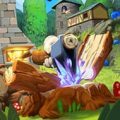
 Monster Nomster drops you into a dungeon as Kram, a koblin whose dragon mistress has been captured, and the rules are set before your first shot fires: everything in these rooms wants to eat you, but you get to eat them right back. This vore-like action shooter built its audience on that one reversal — the prey becomes the predator — and the loop it wraps around that idea is tighter than its low-fi presentation suggests. Three zones, three bosses, three possible endings, and a perk tree that mutates every run into something your last one wasn’t.
| Genre | Vore-like action shooter / roguelite |
| Platform | Windows, Android |
| Zones | 3 (Stone Delve, Fungal Forest, Cosmic Cavern) |
| Version | 1.0 (full release) |
| Endings | 3 |
The belly is the resource the whole game is built around. When Kram swallows an enemy, the belly size counter ticks up. Digest your catch and you recover health — except on Hard mode, where normal digestion heals nothing, which changes absolutely everything about how you approach a room. Belly size has a hard ceiling in any given encounter, and exceeding it causes problems, so you are constantly making a read on whether to gulp another enemy or clear space first. New players almost always ignore this and stuff Kram without thinking, then hit a wall when the belly counter locks them out of fishing mechanics needed to progress the floor.
Fishing is one of Monster Nomster’s stranger systems and the one that catches most first-timers off guard. Sparkles appear at a fishing spot on certain floor types, and you need to fish three times — successful or not — to activate the portal or trigger the boss. The catch: you cannot cast until Kram’s belly is at size zero. If you’ve been gulping everything in sight, you have to digest down before the floor will let you leave. That single detail reshapes the pacing of every run once you understand it.
Artifacts add another layer. Items like the Lunchbox or Reusable Bomb charge up over levels and provide effects beyond the standard perk pool. Perk selection happens after defeating elite rooms, with Span offering upgrades on a branch of choices — and it was a selection from Span that once triggered an infamous level-cap exploit back in earlier builds. The community called it the infinite level glitch, and while it’s long patched, it’s a good example of how tightly the belly, perk, and floor systems interlock.
The Flame Drake is the zone 1 boss, and it is the moment Monster Nomster stops being a warm-up. Fire spouts and projectiles come fast enough that players learning the game for the first time often hit game over here before they’ve established a working perk build. The color-coded warning system on the Drake’s attacks was added specifically because the community flagged readability as a problem — a fact worth knowing if you keep taking hits you feel you shouldn’t be seeing.
Visitors are a distinct encounter type that sit outside the normal room loop. Meeting a visitor means entering a special level with a specific character — Larwin is one, Tezzie the orange lizard is another — and outcomes range from gaining a unique visitor perk to something more chaotic. Two Larwin encounters in a single run used to cause the game to freeze, which gives you a sense of how much personality these meetings inject and how much edge-case testing they require. The poker dice minigame, added later, pits Kram against one of four special visitors in a hand of dice poker where a straight ranks above a full house, making it mechanically distinct from anything else in the run.
Zazika, a lightning-ball perk tied to a visitor encounter, is the kind of upgrade that experienced players plan their early rooms around. Buddy is another — a companion that rides in Kram’s belly at size one and fires acid shots. Getting Buddy early and learning not to use Acid Artillery while Buddy is stored changed how a meaningful slice of players approach zone 2 entirely.
Zone 1, the Stone Delve, functions as the game’s tutorial in everything but name. Enemies telegraph clearly, the perk pool is manageable, and the portal system becomes legible with a few runs. By the time you reach the Fungal Forest — zone 2, added in the major Fungal Forest update — six new enemy types arrive alongside a redesigned boss and a perk pool that includes the Beetle Buffet and Spectral Claw. Players who coasted through zone 1 on reflexes alone find zone 2 demanding a build, not just movement skill.
The Cosmic Cavern, zone 3, is where the game’s pace shifts completely. Enemies are faster, elite rooms appear more frequently, and the final boss fight — the captor of Kram’s dragon mistress — tests everything accumulated across the run. The boss angry mode speed was specifically reduced in a late patch because the community flagged it as a difficulty spike that felt punishing rather than fair, a distinction Monster Nomster’s players care about enough that they documented it in detail. Whether that fix landed right is still debated.
Yes, substantially. Hard mode removes healing from normal digestion, which means the health-recovery cycle that carries most players through the first two zones stops functioning. You can no longer afford to gulp recklessly and digest for recovery. This pushes players toward defensive perks, shield-generating abilities gained from the Internal Struggle minigame, and much more careful belly management throughout every room.
After the rework, Explosive Revenge deals flat damage to all enemies in an area around Kram rather than dealing bonus damage specifically to the predator. It no longer stacks unpredictably with the Flame Drake fight, which was the main reason it was revised. The flat-damage version is more reliable in crowds but less explosive in the specific situations the original perk was famous for — a trade the community has mixed feelings about.
Monster Nomster saves progress at the completion of each floor. If you hit a softlock mid-level, the intended fix is to return to the main menu and use Continue Delve, which resets and rebuilds the current floor. You don’t lose progress from completed floors this way, but anything you did on the current floor — perks from elite rooms, artifacts collected — goes back to its pre-floor state. It is not an ideal system, and the community has flagged it repeatedly as a design area the game could improve.
Monster Nomster is the kind of project that earns goodwill through accumulation — each patch adding a visitor, a perk, a zone — rather than arriving complete. Playing Kram from the Stone Delve into the Cosmic Cavern, building toward a Zazika lightning synergy or stacking Buddy correctly for zone 3, you feel the game’s history in its seams. That’s not a criticism. It’s why runs that hit right feel genuinely crafted rather than procedurally handed to you.


There are no reviews yet. Be the first one to write one.
 Optimized by Seraphinite Accelerator