

 (No Ratings Yet)
 Loading...
Fullscreen















![Hello Kitty [HORROR]](https://gamefyno.com/wp-content/uploads/2025/03/hello-kitty-horror-1.jpg "Hello Kitty [HORROR]")
 (No Ratings Yet)Loading...
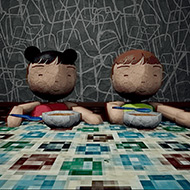
 In We Gotta Go you and your group start in a single sealed interior space with a shared countdown already ticking, and nobody is getting out by themselves. The game’s entire structure hangs on one blunt fact: this is not a game you can solve alone, no matter how good your reflexes are.
| Perspective | First-person, cooperative |
| Objective | One shared goal per session |
| Core Pressure | A shared, limited resource or condition |
| Design Focus | Mandatory group coordination |
Unlike horror games where a skilled solo player can carry a group, We Gotta Go is built so that certain interactions simply cannot be completed by one person. Some doors, mechanisms, and puzzle elements require multiple players acting at once, which means a team that splits up to cover more ground quickly discovers that ground covered alone often can’t actually be used for anything.
New players consistently try to treat this like a normal exploration game, sending one person ahead to scout while others hang back. That instinct gets punished fast, since the game routes critical information and access points specifically so that isolated players end up locked out of progress the group actually needs.
A shared condition, tracked at the group level rather than per player, defines how long any given session can realistically continue, and every second spent wandering unfamiliar rooms eats into that shared margin. This turns basic navigation into a genuine team decision: does the group backtrack to confirm a path is safe, or push forward on partial information because the clock won’t wait for certainty.
Because the pressure is shared rather than individual, one player’s mistake, wasting time on a dead end, wandering off from the group, can cost everyone equally. That collective stake is what gives We Gotta Go its particular tension, distinct from horror games where only the unlucky player who gets caught actually suffers a consequence.
The enclosed spaces in We Gotta Go are deliberately unfamiliar on a first pass, with layouts that reward careful group movement over individual bravado. Certain rooms hide information, a clue, a switch, a piece of context, that only becomes useful once shared verbally with teammates who are elsewhere in the space, reinforcing that communication is as much a tool here as movement itself.
Players who’ve spent real time with We Gotta Go often describe the moment a group finally clicks, splitting attention without splitting up physically, relaying details constantly, as the point where the game stops feeling stressful in a bad way and starts feeling stressful in the way it’s actually designed to be.
Discussion around We Gotta Go tends to center on how differently the same room can play out depending entirely on how well a specific group communicates, which gives it more replay variety than its relatively contained scope might suggest. A frequent point of debate is whether the mandatory cooperation makes solo or mismatched-communication groups unfairly punished, since a team that doesn’t talk much can genuinely struggle regardless of individual skill.
We Gotta Go isn’t interested in individual heroics, and once a group accepts that, the shared countdown stops feeling like an obstacle and starts feeling like the one thing actually holding everyone together.


There are no reviews yet. Be the first one to write one.
 Optimized by Seraphinite Accelerator