 (No Ratings Yet)
 Loading...
Fullscreen












![Hello Kitty [HORROR]](https://gamefyno.com/wp-content/uploads/2025/03/hello-kitty-horror-1.jpg "Hello Kitty [HORROR]")
 (No Ratings Yet)Loading...
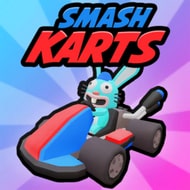
 Smash Karts looks like a cute browser racer but plays like a free-for-all demolition derby where crossing the finish line first was never actually the goal. There’s no lap counter here worth watching; the only number that matters is how many opponents you’ve turned into wreckage before they do the same to you.
| Format | Multiplayer kart battle arena |
| Weapons | 11, from homing rockets to shrink rays |
| Maps | Graveyard, Sky Arena, Desert, and seasonal arenas |
| Modes | Free For All, Capture the Flag, and more |
The moment you spawn into a match, Smash Karts makes its priorities obvious: pickup boxes scattered around the arena matter more than the track layout itself. Weapon pickups respawn roughly every ten seconds, and controlling the routes between them becomes the real skill, since a kart with no weapon in hand is just a target waiting for someone else’s rocket.
New players often keep driving in the racing-game mindset, hugging the fastest line around the arena instead of circling toward whichever pickup just spawned. That habit gets punished quickly once an opponent who understands the loop starts stacking eliminations off predictable, weapon-starved drivers.
The arsenal in Smash Karts covers a surprising range of playstyles: homing rockets and triple rockets for direct aggression, proximity mines and TNT for area denial, oil slicks and spiked bumpers for punishing anyone tailing you too closely, and situational tools like the shrink ray and grenades for disrupting a fight from range. Each weapon rewards a different approach, and matches tend to swing based on who adapts their driving to whatever they just picked up rather than sticking to one favorite tool regardless of situation.
Turbo boosts and invincibility stars round out the pickup pool, and knowing when to grab mobility over offense is one of the subtler decisions Smash Karts asks of experienced players. A turbo boost used to escape a mine-laden corridor is often worth more than another rocket you might not even get a clean shot with.
Free For All is the default entry point, where every smash counts as a point and the highest score at the end takes the match, but Smash Karts spreads its identity across several other modes too. Capture the Flag turns the same chaotic weapon pool into a team objective, Hat Holder forces whoever’s ahead to survive under pressure while holding a target on their kart, and Gem Collector plus Candy Rush both add a risk-reward layer where getting smashed means dropping whatever you’ve gathered.
Team Deathmatch and Score Mode lean further into structured competition, rewarding coordinated groups over lone aggressive drivers. Switching between these modes changes which weapons matter most: mines are far more valuable in Hat Holder, where forcing the target to slow down is the whole strategy, than in a straightforward Free For All scramble.
The Graveyard, Sky Arena, and Desert maps each favor different weapons purely through their layout. Sky Arena’s tighter platforms make oil slicks and spiked bumpers devastating in corners, while Desert’s wider lanes give homing rockets more room to actually connect before a target can juke out of range. Seasonal maps that rotate in around Halloween and other events add temporary variety, and players who learn a map’s choke points quickly tend to out-position opponents who are still treating every arena the same way.
Kart and character customization through the garage is purely cosmetic, but it’s become a genuine identity layer for the community, with players trading opinions on which skins look best paired with which kart body. None of it affects handling or weapon behavior, which keeps the competitive side of Smash Karts fair regardless of how much time someone’s put into unlocking cosmetics.
Homing rockets are the most forgiving starting weapon since they track targets automatically, reducing the aiming pressure that trips up players still learning the arena layouts and kart handling.
Steering immediately toward cover or a nearby weapon pickup rather than driving into open lanes gives freshly respawned karts a fighting chance, since a few seconds without a weapon is the most vulnerable state in any match.
Generally yes, since eliminations get spread across a full team rather than resting entirely on individual positioning, making Team Deathmatch a more approachable entry point for players still getting comfortable with the weapon timing that defines Smash Karts.
Smash Karts never pretends to be about the finish line, and once that clicks, every rocket, mine, and turbo boost on the map starts making a lot more sense as parts of one loud, ongoing argument about who gets to stay on the road the longest.


There are no reviews yet. Be the first one to write one.
 Optimized by Seraphinite Accelerator